
Paths, Drives & Steps
Pathway & Driveway Lighting
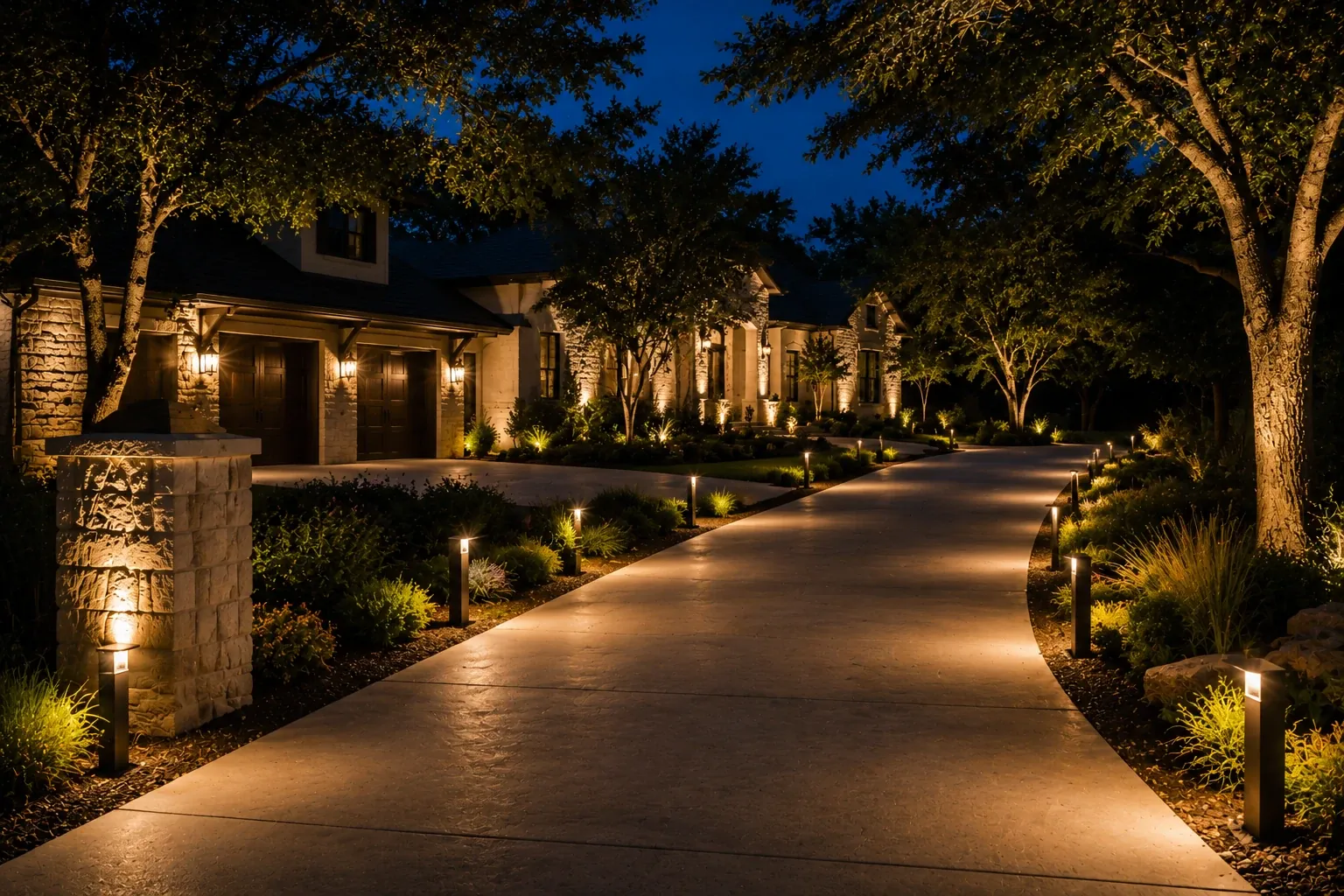
Pathway and driveway lighting in Texas that guides guests from the curb to the door: soft, even pools of light from path lights, bollards and in-grade fixtures, spaced for safety and designed to stay out of everyone's eyes.
Why it matters
Pathway and Driveway Lighting in Texas
Pathway and driveway lighting is the most practical light on a property: it shows where to walk, where the edges are and where the steps begin.
It is also the easiest to get wrong. Too many fixtures in a straight line turns a front walk into a runway. Bright, unshielded lamps blind people at eye level so they see less, not more. Fixtures placed at the edge of a driveway get clipped by tires and mowers.
Landscape Lighting Texas designs paths and drives as part of the whole scene: overlapping pools of light at walking level, staggered so they follow the curve of the path, with surrounding beds and trees lit softly so the walk feels open rather than tunnel-like.
Techniques
How We Light Paths, Drives and Steps
The goal is visible footing and a clear route, with fixtures that look good by day and nearly disappear at night.
Staggered path lights
Shielded path lights placed alternately on each side of a walk, typically 6–10 feet apart, so pools of light overlap softly. Staggering avoids the runway look and follows curves naturally.
Driveway bollards
Low bollards or path lights set back from the edge mark the drive's borders and entry. On long rural drives we light the entrance, curves and the arrival court rather than every few feet.
In-grade & flush lights
Drive-over rated fixtures set flush into pavers or concrete where a raised fixture would be hit. Useful for gate columns, narrow drives and the edges of motor courts.
Step & riser lights
Small louvered fixtures set into risers or retaining walls light each tread. Steps are where most nighttime trips happen, so they get priority in every design.
Moonlighting from above
Where a walk passes under a large tree, a downlight high in the canopy can light the path with dappled leaf shadows and no fixtures at ground level at all.
Bed-edge lighting
Lighting the planting along a path widens the lit area and gives the walk context, so you see the garden on the way in, not just the pavement.
See the difference
Curb to Front Door, Before and After
Drag the slider to compare the approach with and without driveway lighting.
Without lightingWith Landscape Lighting
Specifications
Typical Path & Driveway Fixtures
Low outputs are deliberate: at walking level, less light with good shielding looks better and works better than bright, glaring fixtures.
| Fixture | Typical output | Beam / spread | Color temp | Materials & notes |
|---|---|---|---|---|
| Path light (18–24 in tall) | 80–200 lm | Downward, 6–10 ft pool | 2700K | Brass or copper with hat shield; lamp hidden from view |
| Bollard | 150–300 lm | Downward or 360° | 2700–3000K | Brass, copper or powder-coated; set back from the drive edge |
| In-grade / drive-over light | 100–300 lm | Flush, 25–60° | 2700K | Drive-over rated, sealed for wet locations, drainage base |
| Step / riser light | 40–120 lm | Louvered, downward | 2700K | Brass faceplate, recessed into stone or block |
| Wall / hardscape light | 60–150 lm | Downward wash | 2700K | Mounted under wall caps or in retaining walls |
| Power on long runs | 12V multi-tap transformer, 10-gauge cable or split runs on long drives to control voltage drop. Run the numbers with the transformer & voltage drop calculator. | |||
Texas considerations
Driveway Lighting for Texas Properties
- Long drives: Hill Country and acreage properties can have drives hundreds of feet long. Heavier wire, multiple runs or a second transformer keep the last fixture as bright as the first.
- Clay and caliche: path lights are set on long, sturdy stakes or concrete footings so they stay plumb as soil shrinks and swells.
- Mowers, trimmers and tires: fixtures sit far enough inside beds to avoid damage, and solid brass shrugs off knocks that bend aluminum.
- Limestone and flagstone walks: step lights can be set into stone risers and retaining walls for a clean, built-in look.
- Coastal salt: on the Gulf Coast we specify brass, copper and stainless hardware throughout.
Glare & neighbors
Light the Ground, Not the Eyes
Path and drive lights sit right at eye level for anyone walking or driving past, so glare control matters more here than anywhere else. We use hat-style shields that hide the LED, keep outputs modest and aim light down onto the walking surface.
The result is friendlier to neighbors and HOA rules, and better for dark-sky communities around the Hill Country. It also makes the house safer: your eyes adapt to a softly lit path far better than to a few bright points.
- Shielded optics
- Staggered spacing
- Warm 2700K
- Dusk-to-late timers
Want the path lights on at dusk every night, year-round? Check your city's sunset times by month.
Try it: Texas Dusk TimerSunset and dusk times for your city, with timer settings by month.Our process
How a Path & Driveway Project Works
Free dusk consultation
We walk the route from the street and the driveway to the door as it gets dark, note steps, edges and level changes, and talk through how you and your guests arrive.
Custom design
You get a layout showing fixture spacing, styles and wire runs, with an itemized quote. Paths often share a transformer with facade uplighting and tree lighting.
Expert installation
Licensed, insured installers trench narrow cable runs, bore under walks where needed, and set fixtures plumb and secure. Most front-walk projects finish in a day.
Reveal & tune
After dark we walk the route with you, adjust heights and outputs, and set timers. Work is covered by our 5-year workmanship warranty.
FAQ
Frequently Asked Questions
How far apart should path lights be?
Typically 6–10 feet, staggered on alternating sides of the walk so the pools of light overlap slightly. The exact spacing depends on fixture height, output and how wide the walk is.
Can you put lights in an existing concrete driveway?
Yes. We can core-drill for drive-over in-grade fixtures, and bore under existing walks and drives to run cable without cutting the slab.
Will path lights be too bright for my neighbors or HOA?
Not with shielded fixtures at modest output. Path lights are usually 80–200 lumens with the light directed down onto the walk. If your HOA requires approval, we provide a plan for submission.
How do you keep long driveways evenly lit?
By managing voltage drop: heavier 10-gauge cable, splitting the load into several runs, using multi-tap transformer settings and, on very long drives, a second transformer. Every fixture is checked with a meter during installation.
Are solar path lights a good alternative?
Solar lights are inexpensive but usually dim, short-lived and inconsistent after cloudy days. A professional low-voltage LED system gives reliable, adjustable light every night. See our low-voltage lighting guide for how these systems work.
Keep exploring
Explore Other Services
Combine the approach with the house and garden for a full Landscape Lighting Texas design.
Architectural Uplighting
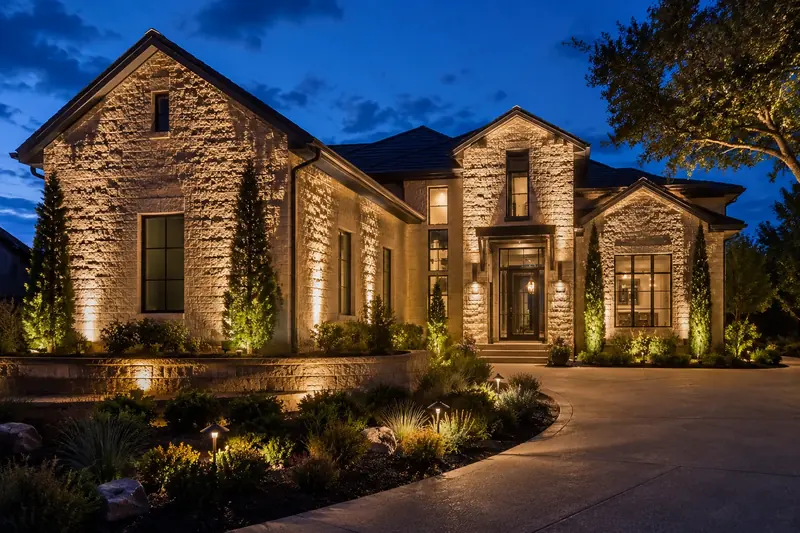
Grazed stone, lit columns and balanced facades that give your home presence after dark.
Explore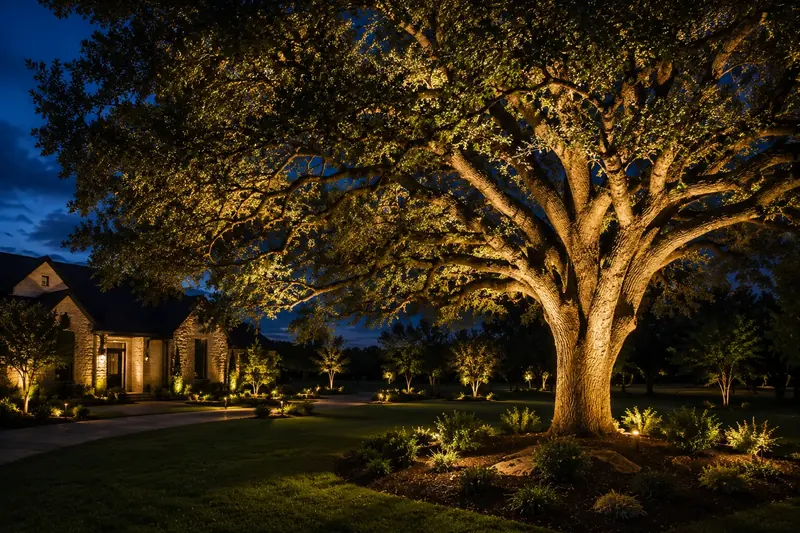
Garden & Tree Lighting
Moonlit live oaks, glowing crape myrtles and planting beds with real depth.
Explore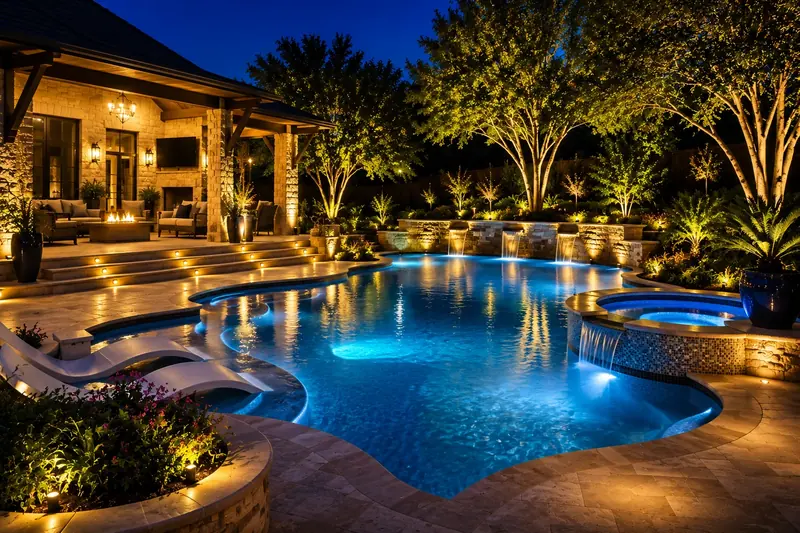
Pool & Water Feature Lighting
Resort-style pools, fountains and patios that come alive at sunset.
Explore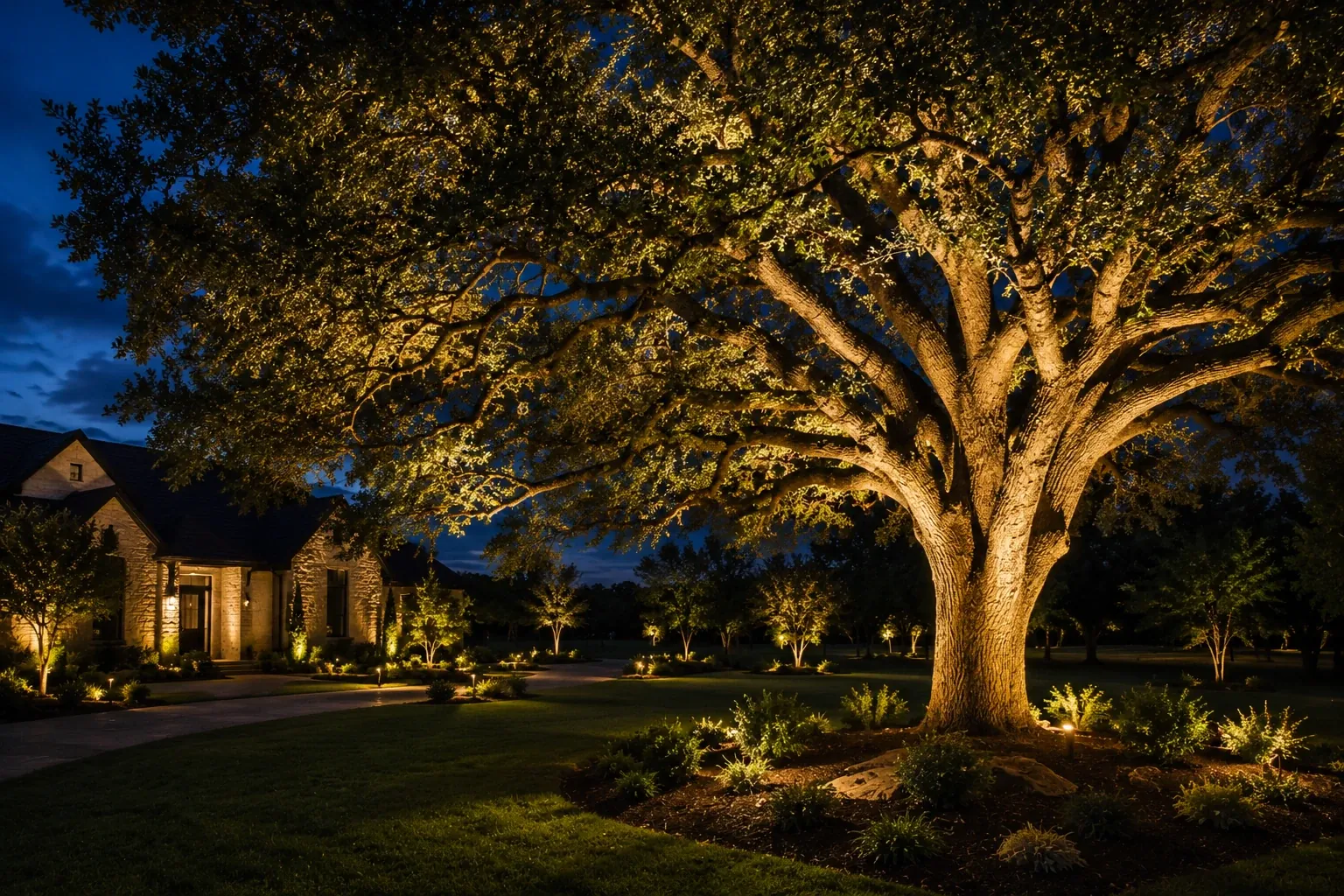
Free Consultation
Ready to Light the Way Home?
Book a free dusk consultation. A Landscape Lighting Texas designer will walk your property at nightfall, show you what is possible and send a clear, itemized quote.