
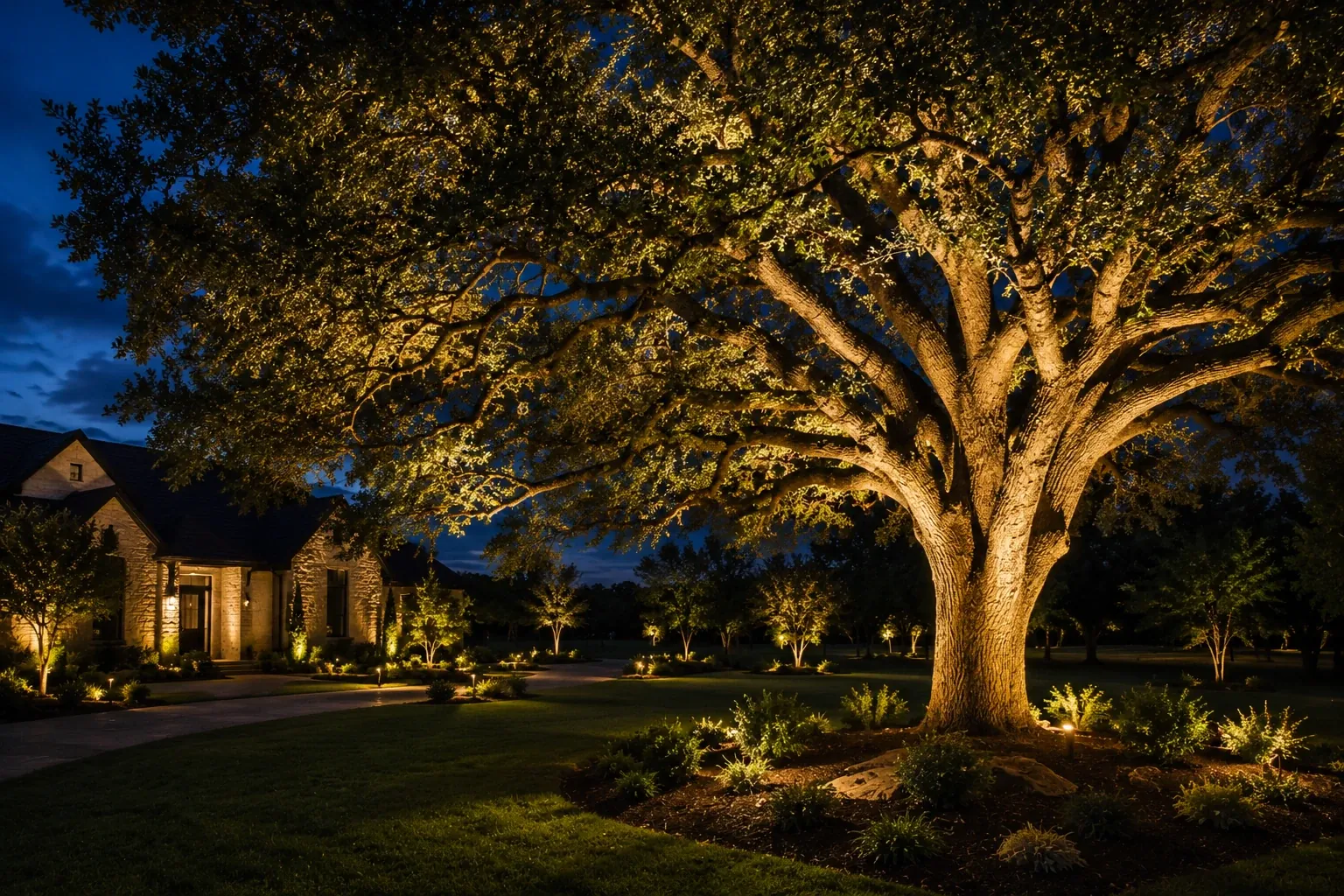
Live Oaks, Gardens & Beds
Garden & Tree Lighting
Tree and garden lighting in Texas that gives your yard depth after dark: moonlit live oaks, glowing crape myrtles, sculptural palms and planting beds lit with warm, efficient LEDs.
Why it matters
Tree and Garden Lighting in Texas
Trees are the largest living features on most Texas properties, and tree and garden lighting is what turns them from dark masses into the backbone of the night landscape.
A lit live oak can frame a house better than any fixture on the house itself. A couple of uplit crape myrtles give a backyard a far wall. Low accents in the beds fill the middle ground so the yard has foreground, middle and background, the same depth it has during the day.
Landscape Lighting Texas designs garden and tree lighting around how each plant grows: the spread of the canopy, the texture of the bark, how much it will fill out in five years, and where you will be standing when you look at it.
Techniques
Ways to Light Trees and Gardens
Different trees reward different techniques. We often combine two on the same tree.
Uplighting
Two or three fixtures at the base, aimed into the canopy from different sides. On a live oak, light rakes across the trunk and the underside of the spreading limbs, creating the cathedral effect people photograph.
Moonlighting
Fixtures mounted high in a mature tree and aimed down through the branches. Light filters through the leaves and casts soft, moving leaf shadows on lawns, patios and paths, like a bright full moon.
Cross-lighting
Lighting a tree from two or more angles so it reads in three dimensions from every viewpoint, not just from the street. Essential for specimen trees seen from both the house and the drive.
Silhouetting
Lighting the wall or fence behind a plant so it stands out as a dark, graphic shape. Works beautifully with agave, yucca, sotol, Japanese maples and sculptural palms.
Trunk grazing
A narrow beam tight to the trunk to show bark texture on palms, crape myrtles and sycamores. On palms, a second fixture often reaches the crown.
Bed & accent lighting
Low, wide-spread area lights and small spots on ornamental grasses, boulders and statuary. They connect lit trees to the house so the garden does not look like islands of light.
Texas trees
Lighting Live Oaks, Crape Myrtles and Palms
Live oaks are the classic Texas subject. Their wide, low canopy wants several wider-beam uplights around the drip line plus, on mature trees, a few moonlights. Our guide to lighting live oak trees goes deeper.
Crape myrtles have sculptural multi-stem trunks. A pair of narrow uplights inside the canopy shows the smooth bark year-round, even after the leaves drop.
Palms along the coast and in Houston and the Rio Grande Valley look best with one fixture grazing the trunk and one wider fixture reaching the fronds.
Cedar elms, pecans and magnolias each get a plan based on height and density; dense magnolias often look better lit from outside the canopy.
Planning
Get the Beam Right
The most common mistake in tree lighting is the wrong beam angle: a narrow spot on a broad oak lights a stripe up the trunk and leaves the canopy dark, while a wide flood on a slender palm wastes light on the lawn.
A rough guide: narrow 15–25° for tall, slender trees; medium 36° for most single-trunk trees; wide 45–60° for broad canopies. Enter your tree's height and spread to check.
Try it: Beam Spread CalculatorFind the beam angle that covers a tree, wall or column perfectly.See the difference
From Dark Mass to Night Landscape
Drag the slider to compare a live oak at night with and without uplighting.
Without lightingWith Landscape Lighting
Specifications
Typical Fixtures for Tree & Garden Lighting
Planning starting points. We adjust output on site once fixtures are lit.
| Fixture | Typical output | Beam angle | Color temp | Materials & notes |
|---|---|---|---|---|
| Small-tree uplight (crape myrtle, Japanese maple) | 150–300 lm | 25–36° | 2700–3000K | Brass or copper, glare cowl |
| Large-tree uplight (live oak, pecan) | 400–800 lm | 36–60° | 2700–3000K | Brass, adjustable knuckle, 2–4 per tree |
| Palm trunk & crown | 300–600 lm | 10–25° trunk, 36° crown | 3000K | Brass or copper; well lights in turf |
| Moonlight (tree-mounted downlight) | 150–400 lm | 36–60° | 2700–3000K | Brass, stainless hardware, expandable tree mount |
| Bed / area light | 80–200 lm | 360° spread | 2700K | Low profile, hat shields light downward |
| Silhouette wall wash | 150–350 lm | 60°+ | 2700K | Placed behind the plant, aimed at wall or fence |
Texas considerations
Built for Texas Soil, Storms and Growing Seasons
- Protecting roots: around mature live oaks we route cable carefully and keep trenches shallow and narrow to avoid damaging feeder roots.
- Healthy tree mounts: moonlights use expandable mounts and stainless hardware that allow for growth, never wire wrapped around a limb.
- Clay and caliche: fixtures are set on stakes sized for the soil so shrink-swell cycles do not knock them off aim.
- Hail, mowers and string trimmers: solid brass bodies and protected placement keep fixtures intact.
- Fast summer growth: plants grow quickly here, so we leave slack in the cable and revisit aim during an annual tune-up.
- Oak wilt and pruning seasons: we coordinate tree-mounted work with your arborist so climbing and mounting happen at the right time of year.
Our process
How a Tree & Garden Lighting Project Works
Free dusk consultation
We walk the yard as it gets dark, note which trees and beds anchor each view from the house, patio and street, and test-light a tree if it helps you decide.
Custom design
A plan marks every fixture by tree and bed, with beam angle, output and color temperature, plus zones so the backyard can run later than the front. You get a clear, itemized quote.
Expert installation
Our licensed installers place fixtures, mount moonlights, and bury 12- or 10-gauge cable with minimal disruption to roots, turf and beds.
Reveal & tune
After dark we walk the garden with you and adjust every fixture until the trees, beds and paths feel balanced. All work carries a 5-year workmanship warranty.
FAQ
Frequently Asked Questions
How many lights does a large live oak need?
Usually two to four uplights around the trunk and drip line, depending on canopy spread. A mature oak that shades a patio or lawn can also take two to six moonlights high in the branches.
Will lights or mounts hurt my trees?
No, when installed correctly. We use expandable tree mounts and stainless hardware that allow for growth, avoid wrapping wire around limbs, and keep trenching narrow and shallow around root zones.
What is the difference between uplighting and moonlighting?
Uplighting places fixtures on the ground aimed up into the tree to show the trunk and canopy. Moonlighting places fixtures high in the tree aimed down, casting soft leaf shadows onto the ground below. Many designs use both.
Should garden lighting be 2700K or 3000K?
Both work. 2700K matches the warm light on most facades; 3000K can make foliage look a little greener and crisper. We keep color consistent within each view. The color temperature visualizer shows the difference.
What happens as my plants grow?
Adjustable fixtures and extra cable slack let us move or re-aim lights as the garden matures. An annual tune-up keeps everything aimed where it should be.
Keep exploring
Explore Other Services
Pair your trees with the house and paths for a complete Landscape Lighting Texas plan.
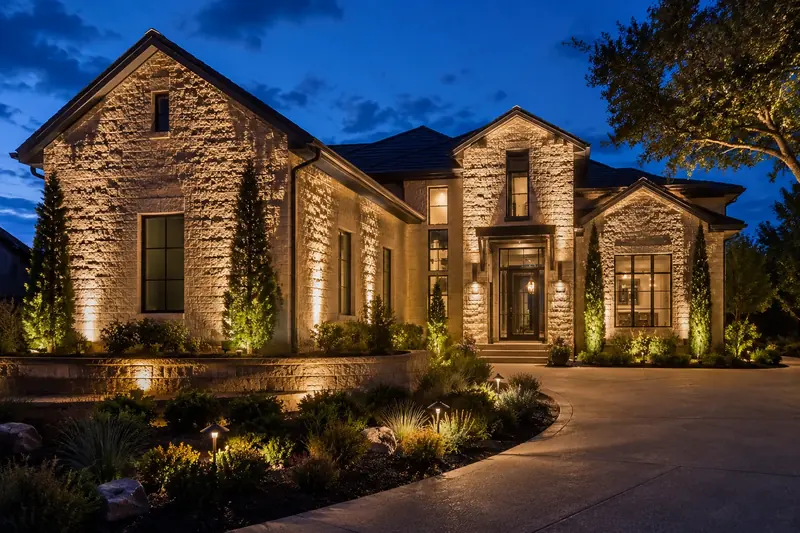
Architectural Uplighting
Grazed stone, lit columns and balanced facades that give your home presence after dark.
Explore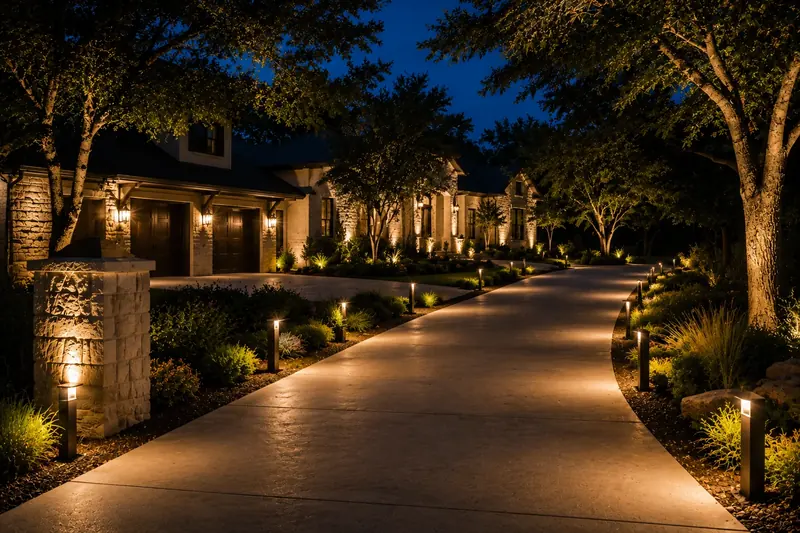
Pathway & Driveway Lighting
Soft pools of light that guide guests from the curb to the door, safely.
Explore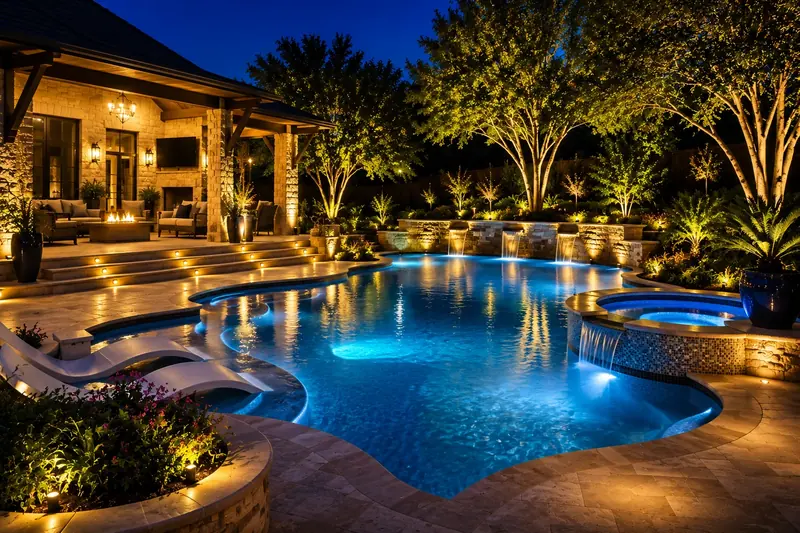
Pool & Water Feature Lighting
Resort-style pools, fountains and patios that come alive at sunset.
ExploreFree Consultation
Ready to See Your Trees in a New Light?
Book a free dusk consultation. A Landscape Lighting Texas designer will walk your property at nightfall, show you what is possible and send a clear, itemized quote.