How to Light Live Oak Trees
Knowing how to light live oak trees well is one of the most valuable skills in Texas landscape lighting. A mature live oak is often the single biggest feature on a property: wide, low, twisting limbs and a dense evergreen canopy that looks good every month of the year. Light it carelessly and it becomes a flat green blob with a hot spot on the trunk. Light it with care and it becomes the centerpiece of your whole night scene.
This guide covers the three main techniques, how many fixtures you need for a given canopy, which beam angles and outputs to use, where to place fixtures, and how to protect the roots and the tree itself during installation.
Uplighting vs moonlighting vs downlighting
Each technique creates a different effect. Most great live oak designs combine at least two.
Uplighting
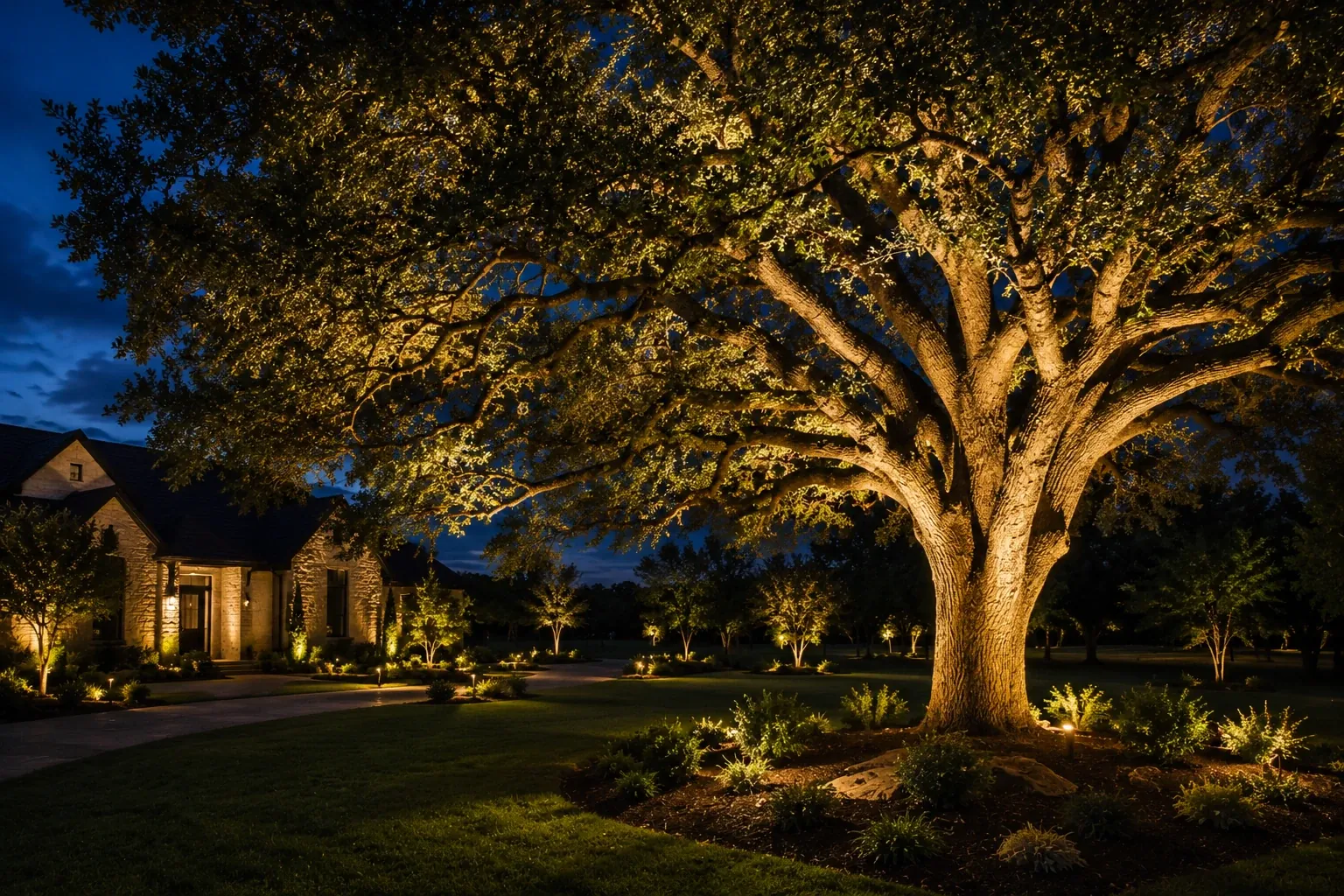
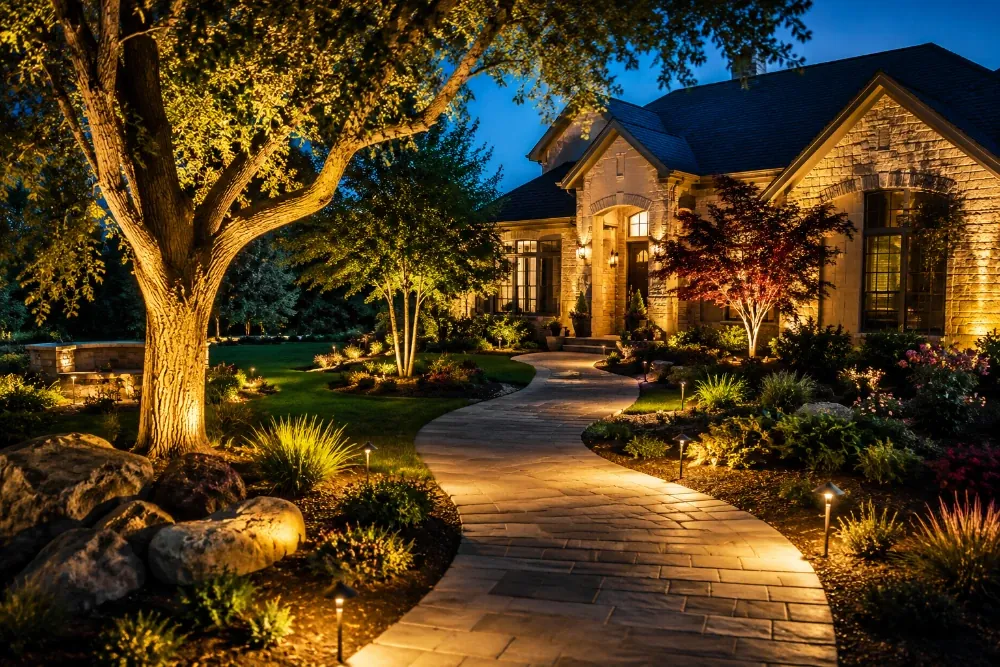
Fixtures sit on the ground and aim up into the tree. Uplighting shows off the trunk, the sweep of the main limbs and the underside of the canopy. It is the most common technique and the easiest to adjust. On a live oak, the goal is to light the structure, not just the leaves: aim some fixtures at the trunk and inner limbs and others toward the outer canopy.
Moonlighting
Fixtures mount high in the tree, typically 20–30 feet up, and aim down through the branches. The light passes through the leaves and casts soft, dappled shadows on the lawn, patio or driveway below, like moonlight through the canopy. Moonlighting is subtle and natural, and it doubles as useful ambient light for outdoor living spaces under the tree.
Downlighting
Downlighting is a broader term for any fixture aimed down from above, from a tree, an eave or a pergola. In a tree it is usually a more focused version of moonlighting, used to light a specific area such as a seating group, a path or a driveway turnaround.
How many fixtures does a live oak need?
The right count depends mostly on canopy width, because live oaks are almost always wider than they are tall. A single fixture lights one side and leaves the tree looking flat. Use this table as a starting point:
| Canopy width | Uplights | Optional moonlights | Typical output per uplight |
|---|---|---|---|
| Under 20 ft (young oak) | 1–2 | None | 300–500 lumens |
| 20–35 ft | 2–3 | 1–2 | 400–700 lumens |
| 35–50 ft | 3–4 | 2–3 | 500–900 lumens |
| 50 ft and wider (heritage oak) | 4–6 | 3–4 | 700–1,200 lumens |
These are planning ranges, not rules. A tree viewed mainly from one side, such as a front-yard oak seen from the street, can often be lit with fewer fixtures concentrated on the visible face. An oak in the middle of a backyard that you see from all sides needs fixtures all the way around it.
Choosing beam angles
The beam angle controls how wide the light spreads. Narrow beams reach high and pick out the trunk and limbs; wide beams fill the canopy with softer light.
| Beam angle | Best use on a live oak |
|---|---|
| 10–15° (spot) | Grazing the trunk, picking out one dramatic limb, reaching tall canopies |
| 25° (narrow flood) | Main limbs and the inner canopy; the workhorse for most oaks |
| 36–40° (flood) | Filling the underside of a broad canopy from a few feet back |
| 60° (wide flood) | Wide, low canopies and wash light across outer branches |
On a typical mature oak, a mix works best: one narrow beam aimed up the trunk and into the main fork, plus wider beams spread toward the outer canopy.
Try it: Beam Spread CalculatorFind the beam angle that covers a tree, wall or column perfectly.How many lumens?
LED landscape fixtures for trees typically range from 300 to 1,200 lumens. Live oak leaves are small, dark and glossy, so they absorb more light than a pale-barked tree. That said, more is rarely better. A tree that outshines the house throws off the whole design. Start in the middle of the range and use dimmable fixtures or a multi-tap transformer so you can fine-tune output on-site after dark. Our post on LED vs halogen landscape lighting explains why LEDs give you more control at a fraction of the running cost.
Fixture placement: distance from the trunk
Where you put the fixture matters as much as what you put in it.
- Trunk grazing: 1–2 feet from the trunk, aimed nearly straight up with a narrow beam. This brings out bark texture and the twist of the trunk.
- Limb and canopy lighting: 3–6 feet from the trunk, aimed outward and up into the main limbs.
- Outer canopy: near the drip line or just inside it, aimed back toward the center so the edge of the canopy glows.
- Moonlights: high on main limbs, 20–30 feet up, aimed down through gaps in the foliage rather than through solid leaf mass.
Place most uplights on the side of the tree that faces the main viewing points (the street, the patio, the main windows), aimed away from viewers and into the tree. That way people see the lit trunk and canopy, not the lamp.
Protecting live oak roots and health
Live oaks are long-lived, valuable and sensitive. A good lighting installation leaves no lasting mark on the tree.
Hand-trench near the tree
Most of an oak's feeder roots are in the top 12–18 inches of soil and extend well past the drip line. Low-voltage landscape lighting wire typically only needs to be buried a few inches deep, so there is no reason to use a trencher near a tree. Near the trunk, we hand-dig narrow slits or pull wire through with a flat spade, working around roots rather than cutting them.
No trenching inside the critical root zone
A common rule of thumb for the critical root zone is a radius of about 1 foot for every inch of trunk diameter. Inside that zone, avoid trenching, heavy equipment and soil compaction. Bring wire to the fixture with a shallow slit or route it along the edge of a bed, and keep transformers, junction points and hubs outside the zone.
Respect oak wilt season
Oak wilt is a serious fungal disease in Central Texas and the Hill Country, and live oaks are especially vulnerable. Texas A&M Forest Service guidance is to avoid pruning or wounding oaks from February through June, when the insects that spread the fungus are most active. In practice that means no new tree mounts, no lag screws in limbs and no root cutting during those months. If a wound is unavoidable at any time of year, paint it immediately with a wound dressing or latex paint.
Mount fixtures without girdling
Tree-mount fixtures should be attached with a single stainless lag or an adjustable strap that leaves room for growth. Never wrap wire tightly around a limb. Run wire up the trunk in a UV-stable conduit or a loose channel and leave a service loop so the tree can grow without pulling on the cable.
Wiring tree lights the right way
Large oaks often sit far from the house, so the wire runs are long. Voltage drop over a long run makes the farthest fixtures dimmer and can shift their color. Use 12- or 10-gauge low-voltage cable for longer runs, consider hub wiring so every fixture in the tree gets the same voltage, and power the zone from a multi-tap transformer so you can compensate for distance. Keep connections above grade or in sealed, waterproof connectors, since Texas clay holds water after heavy rain. Our transformer and voltage drop calculator helps size the run.
Glare control
Glare is the most common complaint about tree lighting. A bright lamp seen directly from the street, a window or the patio is uncomfortable and ruins the effect.
- Use fixtures with deep shrouds or glare cowls so the light source is recessed.
- Aim uplights away from the main viewing direction.
- Use well lights flush with the ground in lawn areas so there is nothing to see or trip over.
- Use honeycomb louvers on high-output fixtures near patios and pools.
- Check every fixture from the street, the driveway and inside the house before calling the job done.
Color temperature for live oak foliage
2700K is the default choice for live oaks. It brings out the warm browns and grays of the bark and gives the dark green leaves a rich, natural tone. 3000K works on oaks near a modern or white facade where the whole design runs a little cooler. Avoid 4000K and above on trees; the leaves turn bluish and flat, and cool light is harder on night skies and wildlife. Our color temperature guide goes into more detail.
Common mistakes to avoid
- One light on a big tree. It lights a single face and makes the oak look flat.
- Over-lighting. A tree brighter than the house pulls the eye away from everything else.
- Aiming into the lens line of sight. Glare from the street or the patio.
- Trenching through roots. Machine trenchers cut feeder roots and can damage the tree for years.
- Wounding oaks in spring. Mounting fixtures between February and June raises oak wilt risk.
- Mixing color temperatures. A cool fixture next to warm ones stands out immediately.
- Forgetting growth. Fixtures that are perfect today may be buried in branches in three years.
Maintenance as the tree grows
Live oaks keep growing, and a lighting design needs to grow with them. Plan for a check-up once or twice a year:
- Re-aim uplights as the canopy widens or limbs drop with weight.
- Trim foliage around fixtures, and leave openings where moonlights shine through.
- Loosen straps and check tree mounts for any sign of growing into the bark.
- Clean lenses after the spring leaf drop, when live oaks shed old leaves and pollen.
- Move or add fixtures as the tree expands past the original layout.
Our maintenance checklist lists seasonal tasks, and the Landscape Lighting Texas maintenance and repair service handles re-aiming, retrofits and repairs for any brand.
Frequently Asked Questions
How many lights does it take to light a large live oak?
Most mature live oaks with a 35–50 foot canopy look best with three to four uplights and two or three optional moonlights. Smaller trees may only need one or two fixtures.
Does landscape lighting harm live oak trees?
Not when installed properly. Use hand trenching near roots, avoid the critical root zone, mount fixtures without girdling and avoid wounding oaks from February through June because of oak wilt.
What beam angle is best for uplighting a tree?
A 25° beam is the most versatile choice for oak limbs and inner canopy. Use 10–15° for the trunk or very tall trees and 36–60° for broad, low canopies.
Is moonlighting worth it?
For large oaks over a patio, lawn or driveway, yes. Moonlighting creates the most natural-looking effect in landscape lighting and adds gentle, useful light to the space below the tree.
Have a live oak that deserves to be seen after dark? Landscape Lighting Texas offers free dusk consultations for tree and garden lighting, with careful, root-safe installation. Request your free quote and we will plan a design for your trees.

Our lighting designers have planned and aimed more than 1,400 outdoor lighting systems across Texas. More about us.