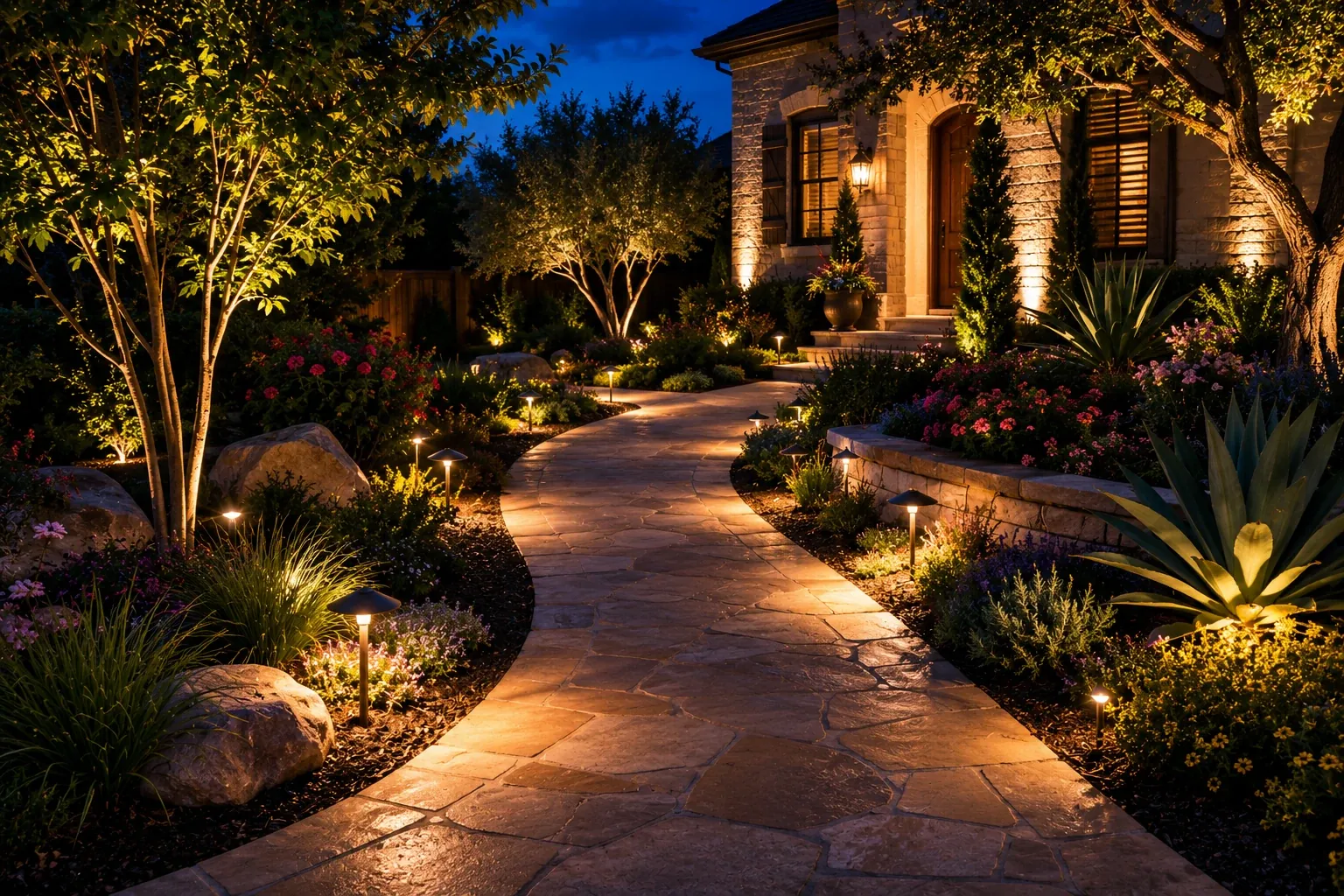
LED vs Halogen Landscape Lighting
If your yard still runs on halogen bulbs, the LED vs halogen landscape lighting question comes down to more than a lower electric bill. LEDs use roughly 75–80% less power, last ten times longer or more, run far cooler and let you shrink transformers and wire. Halogen still has a few things going for it, mainly a low purchase price and beautiful color. This guide compares the two on every point that matters to a Texas homeowner, works through the real cost at Texas electricity rates, and explains when a simple lamp swap makes sense and when it is time for new fixtures.
Most systems installed before about 2012 were built around 12-volt halogen lamps, usually the MR16 bi-pin spot or flood and the small T3 or JC capsule in path lights. Plenty of those systems are still in the ground, and many of them can be converted. Others are worn out and are better replaced. Knowing the difference saves money either way.
LED vs Halogen at a Glance
Here is how a typical 20-watt MR16 halogen lamp compares with the 4–5 watt LED lamp that replaces it in most landscape fixtures.
| Factor | 20W MR16 halogen | 4–5W LED (MR16 or integrated) |
|---|---|---|
| Power draw | 20W (35W and 50W also common) | 4–5W for similar light output |
| Rated life | About 2,000–4,000 hours | About 30,000–50,000 hours (to 70% output) |
| Lens and housing heat | Very hot; can scorch foliage and burn fingers | Warm at the heat sink, safe to touch at the lens |
| Color rendering (CRI) | ~100, the reference standard | 80–95+ depending on quality |
| Color consistency | Very consistent lamp to lamp | Varies by brand and binning; good lamps match well |
| Dimming at end of run | Dims and yellows with low voltage | Many hold output across a wide voltage range |
| Upfront lamp cost | Low | Higher, though prices have fallen sharply |
| Typical failure | Filament burns out suddenly | Slow fade, or driver failure from heat or moisture |
Energy Use: Why LEDs Win by a Wide Margin
A halogen lamp makes light by heating a tungsten filament, so most of the electricity it draws becomes heat rather than light. An LED converts a much larger share of its power into visible light. In practical terms, a 4–5W LED MR16 produces about the same useful beam as a 20W halogen MR16, and a 7–8W LED can stand in for a 35W halogen.
That is the source of the 75–80% savings figure you see quoted. It holds up well in the field because landscape lighting runs for many hours every night, every night of the year. A small difference per fixture becomes a large difference across 20 or 30 fixtures and 365 evenings.
Lamp Life and the Hidden Cost of Replacing Bulbs
A halogen MR16 is typically rated for about 2,000 to 4,000 hours. If your lights run from dusk to 11 p.m., that is roughly 2,000 hours a year, so you can expect to replace many lamps every one to two years. Run dusk to dawn and halogens may not last a single year.
Quality LED lamps and integrated fixtures are commonly rated for 30,000 to 50,000 hours. That rating usually means the point where output has dropped to 70% of new (called L70), not the point where the light goes dark. At six hours a night, 40,000 hours is more than 18 years of use.
The lamp itself is only part of the replacement cost. Each burned-out halogen means a walk around the yard, opening fixtures, handling hot glass, replacing gaskets that have hardened, and sometimes discovering corroded sockets. If you pay someone to do it, the service call often costs more than the bulbs.
Heat: A Bigger Deal in Texas Than Elsewhere
Halogen lamps run hot enough to brown nearby leaves, melt mulch-level plastics and cause burns if someone grabs a path light. In a Texas August, with ground and air temperatures already high, that heat also cooks gaskets and wire insulation inside the fixture, which is one reason old halogen fixtures leak and corrode.
LEDs are not heat-free. The light itself is cool, but the electronics behind the chip do produce heat, and heat is the main enemy of LED lifespan. That is why quality matters: a good LED lamp or fixture has a real aluminum or brass heat sink, and a well-designed fixture gives that heat somewhere to go. A bargain LED MR16 sealed into a tight, dark-bronze housing on a south-facing wall can fail early in Texas summers.
Light Quality, CRI and Color Consistency
Color rendering
Halogen has a color rendering index (CRI) of about 100, which is why stone, brick and foliage look rich under it. Early LEDs had a poor reputation here, with greenish or flat light. Modern landscape-grade LEDs typically rate CRI 80 to 90, and premium lamps reach 90 or above. For landscape work, CRI 90+ with a strong red value (often listed as R9) keeps red brick, crape myrtle blooms and warm limestone looking natural.
Color temperature
Halogen sits around 2800–3000K and warms further as it dims. LEDs are sold in fixed color temperatures, most often 2700K and 3000K for residential landscapes. That choice is a design decision; our color temperature guide covers which works best on stone, brick, plants and water.
Lamp-to-lamp consistency
Every halogen lamp of a given type looks essentially the same. LEDs can vary from batch to batch and brand to brand. Better manufacturers sort chips tightly (look for 3-step or tighter MacAdam binning) so a row of path lights matches. Mixing brands, or mixing new LEDs with a few leftover halogens, is the most common reason a retrofitted yard looks patchy.
Upfront Cost: Where Halogen Still Looks Cheaper
A halogen MR16 costs very little, and a basic halogen fixture is inexpensive too. A good LED lamp costs several times as much, and a quality integrated LED fixture costs more than a basic halogen fixture. On the shelf, halogen wins.
Over the life of the system it does not. Once you add electricity, replacement lamps and labor, LEDs are almost always cheaper within a few years. For a full planning range on a new professional system, which typically runs $2,500–$12,000 for most Texas homes, see our landscape lighting cost calculator.
Worked Example: Running Cost at Texas Electricity Rates
Here is the math for a common setup: 20 fixtures, each with a 20W halogen MR16, compared with the same 20 fixtures on 5W LEDs. We will use 15¢ per kWh, a reasonable planning figure for many Texas residential plans (check your own bill, since rates vary by provider and plan).
- Dusk to 11 p.m.: about 6 hours a night × 365 = 2,190 hours a year.
- Dusk to dawn: about 11 hours a night on average × 365 = 4,015 hours a year.
- Formula: watts × hours ÷ 1,000 = kWh; kWh × $0.15 = cost.
| Item | Halogen (20 × 20W) | LED (20 × 5W) |
|---|---|---|
| Total lamp load | 400W | 100W |
| kWh per year, 6 h/night | 400 × 2,190 ÷ 1,000 = 876 kWh | 100 × 2,190 ÷ 1,000 = 219 kWh |
| Cost per year, 6 h/night | 876 × $0.15 = $131.40 | 219 × $0.15 = $32.85 |
| kWh per year, dusk to dawn | 400 × 4,015 ÷ 1,000 = 1,606 kWh | 100 × 4,015 ÷ 1,000 = 401.5 kWh |
| Cost per year, dusk to dawn | 1,606 × $0.15 = $240.90 | 401.5 × $0.15 = $60.23 |
| Lamp replacements per year (6 h/night) | Roughly half to all 20 lamps | Typically none |
On the six-hour schedule the LED system saves about $98 a year in electricity; dusk to dawn, about $181. Transformers also lose some energy as heat, and that loss is proportionally larger on a big halogen load, so real-world savings are usually a little higher than the lamp-only math. Add the halogen lamps you no longer buy and install, and a typical LED retrofit pays for itself in a few years. Larger properties with 40 or 60 fixtures see the savings scale accordingly.
Try it: LED Energy SavingsCompare halogen and LED running costs at Texas electricity rates.What Switching to LED Does to Transformer Sizing
Low-voltage transformers are sized by total watts, and good practice is to load them to no more than about 80% of their rating. The halogen system above draws 400W, so it needs at least a 500W transformer. The same layout on LEDs draws 100W, which a 150W or 200W transformer handles with room to spare.
Lower wattage also means lower current. At 12 volts, 400W is about 33 amps, while 100W is about 8 amps. Less current means far less voltage drop on long wire runs, which is why LED systems can use smaller gauge wire, longer runs or fewer home runs than halogen systems. If you are converting, your existing transformer will almost always be more than big enough; the question is whether its taps are now set too high. An over-voltage LED lamp runs hot and dies early. Our low-voltage lighting guide explains taps, wire gauge and voltage drop in detail.
Try it: Transformer & Voltage DropSize a low-voltage transformer and check voltage drop by wire gauge.Retrofit or Replace? Choosing the Right Upgrade
Drop-in LED lamps
A drop-in lamp replaces the halogen bulb in the existing fixture: an LED MR16 for spotlights, or an LED bi-pin (G4) or wedge lamp for many path lights. It is the lowest-cost way to cut energy use and works well when the fixtures themselves are in good shape.
Integrated LED fixtures
An integrated fixture has the LED and driver built in and sealed at the factory. Heat sinking is designed as one system, there is no socket to corrode, and many models let you adjust output or swap optics for a different beam angle. The trade-off is that at the very end of its life you replace the fixture or its LED module rather than a bulb. Given 30,000+ hour ratings, that is a long way off.
When retrofitting makes sense
- Fixtures are solid brass, copper or heavy cast aluminum with intact finishes and lenses.
- Sockets are clean and green-free, and gaskets can be replaced.
- The layout and aiming still suit the landscape as it has grown.
- The wire and connections test well and the transformer is healthy.
When replacing fixtures is the better call
- Fixtures are thin painted aluminum or plastic with peeling finish, cracked lenses or heavy corrosion, which is common near the Gulf Coast.
- Sockets are corroded or the fixture fills with water after rain or irrigation.
- Trees have outgrown the original design and the lights need to move anyway.
- You want features drop-ins cannot give, such as tighter glare control, adjustable output or smart zone control.
Many Texas projects end up as a mix: good brass fixtures get new LED lamps, failing ones are replaced with integrated LEDs, and the transformer and connections are brought up to standard at the same visit. Our maintenance and repair service handles LED retrofits on any brand of system.
Is There Still a Case for Halogen?
Very little. Halogen lamps are getting harder to find as manufacturers move on, and their color advantage has largely closed with high-CRI LEDs. The only real argument is a small system that runs a few hours a week, where the upfront cost of new lamps takes years to pay back. For a typical Texas yard that lights up every evening, LED is the clear choice. At Landscape Lighting Texas, new installations are designed around professional-grade LED fixtures.
Frequently Asked Questions
Can I put LED bulbs in my existing halogen landscape fixtures?
Usually, yes. Most 12-volt halogen MR16 and bi-pin fixtures accept LED replacement lamps of the same base. Choose lamps rated for outdoor, enclosed use, match the beam angle to what the fixture was doing before, and check that the transformer taps are not now delivering too much voltage.
How much will I save by switching from halogen to LED?
Expect roughly 75–80% lower lighting energy use. For 20 fixtures running six hours a night at 15¢ per kWh, that is about $98 a year in electricity, plus the cost of replacement halogen lamps. Run your own numbers with the LED energy savings calculator.
Do LED landscape lights look as good as halogen?
Quality ones do. Choose warm color temperatures (2700K or 3000K) and CRI 90 or higher, and stick to one brand or matched lamps across the property so the color stays consistent.
Do I need a new transformer when I switch to LED?
Rarely for capacity, since LED loads are much smaller. You may need to rewire taps to lower voltage, and an older electronic transformer may need replacing if it flickers with a light load. A failing or corroded transformer should be replaced either way.
Thinking about converting an older halogen system, or starting fresh with LED? Landscape Lighting Texas offers free consultations and estimates across the state. Request your free quote and we will look at what you have and recommend the most cost-effective path.

Our lighting designers have planned and aimed more than 1,400 outdoor lighting systems across Texas. More about us.