Landscape Lighting: The Complete Guide
The right landscape lighting can completely change how a property looks, feels and functions after sunset. A home that seems ordinary by day becomes striking at night when its architecture, trees, pathways and outdoor living areas are lit with intention.
Many Texas homeowners invest heavily in landscaping, patios, outdoor kitchens and gardens. Yet once darkness arrives, those investments disappear into the shadows, often for half of every day. Thoughtful landscape lighting brings those spaces back to life, improves safety, strengthens security and creates an inviting atmosphere you can enjoy through a long Texas outdoor season.
Whether you want more curb appeal, a safer walk to the front door or a resort-style backyard, this guide covers the fundamentals: why lighting matters, the fixture types and techniques designers use, how to plan a layout, what LED and low-voltage systems mean for you, what it costs, and how to keep it all working. It is written by the design team at Landscape Lighting Texas, drawing on more than 1,400 projects across the state.
Why Landscape Lighting Matters
Outdoor lighting is about far more than making things visible. The best systems create an experience, and they earn their keep in four ways.
Enhances Curb Appeal After Dark
A beautifully lit home naturally draws the eye. Strategically placed fixtures can highlight:
- Architectural details such as columns, gables and rooflines
- Stonework and masonry, from Austin stone to brick
- Entryways and front doors
- Landscaping features and planting beds
- Mature trees like live oaks, crape myrtles and palms
- Decorative gardens, walls and water features
Instead of appearing flat and dark, your property gains depth, texture and visual interest. Think of the exterior as a stage: during the day the sun is the spotlight; after sunset, landscape lighting takes over, and you choose what the audience sees.
Increases Safety
Safety is one of the most practical reasons to invest. Poorly lit walks, driveways and stairs create hazards, and even familiar spaces become hard to navigate without good visibility. Areas that commonly benefit from light include:
- Walkways and garden paths
- Front entrances and porches
- Pool decks
- Outdoor steps and changes in grade
- Retaining walls and raised beds
A properly designed system guides visitors naturally and reduces the chance of trips and falls, without blinding anyone along the way.
Improves Security
Dark corners and hidden areas around a home create real concerns. Lighting alone does not prevent crime, but it significantly improves visibility around entry points, garages, side yards, gates and backyard access. Many homeowners find that a well-lit property simply feels more secure, and even, glare-free light helps security cameras capture clearer footage than a single harsh floodlight does.
Extends Outdoor Living
In much of Texas, the most comfortable time to be outside from May to October is after the sun goes down. Patios, outdoor kitchens, pergolas and fire pit areas become usable long after sunset when they are lit correctly. Instead of ending gatherings when darkness arrives, you can entertain well into the evening.
The Main Types of Landscape Lighting
Understanding fixture types helps you make smarter design decisions. Each category serves a different purpose, and most good designs combine several.
| Fixture type | Best for | Typical LED output | Notes |
|---|---|---|---|
| Path light | Walks, garden paths, bed edges | 2–5 W | Hat-style shades push light down and hide the source |
| Uplight / spotlight | Trees, columns, facades, sculpture | 3–10 W | Interchangeable beam angles from about 15° to 60° |
| Well light (in-grade) | Uplighting in turf or near walks | 4–10 W | Flush with the ground, so mowers pass over it |
| Downlight | Patios, trees, eaves, pergolas | 3–8 W | Mounted high; basis of moonlighting |
| Floodlight / wall wash | Large walls, lawns, security zones | 8–20 W | Wide beam; needs shielding to control glare |
| Step, deck and hardscape light | Stairs, seat walls, kitchens | 1–3 W | Low and discreet; light falls on the tread |
| Bollard | Driveways, commercial walks | 4–12 W | Taller and sturdier than path lights |
| Underwater / fountain light | Ponds, fountains, waterfalls | 2–8 W | Must be rated for submersion (IP68) |
Path Lighting
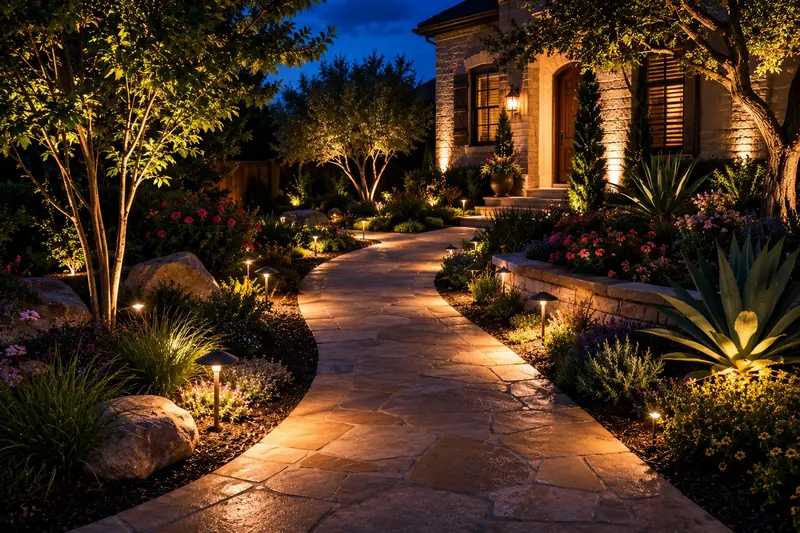
Path lights are the most recognizable landscape fixtures. Installed along walkways and garden paths, they increase safety, improve navigation, define walking routes and add visual appeal. The key is restraint: too many fixtures in a straight line create a runway effect that feels artificial. Staggering lights on alternating sides, roughly 8 to 10 feet apart, produces soft overlapping pools of light instead.
Uplighting
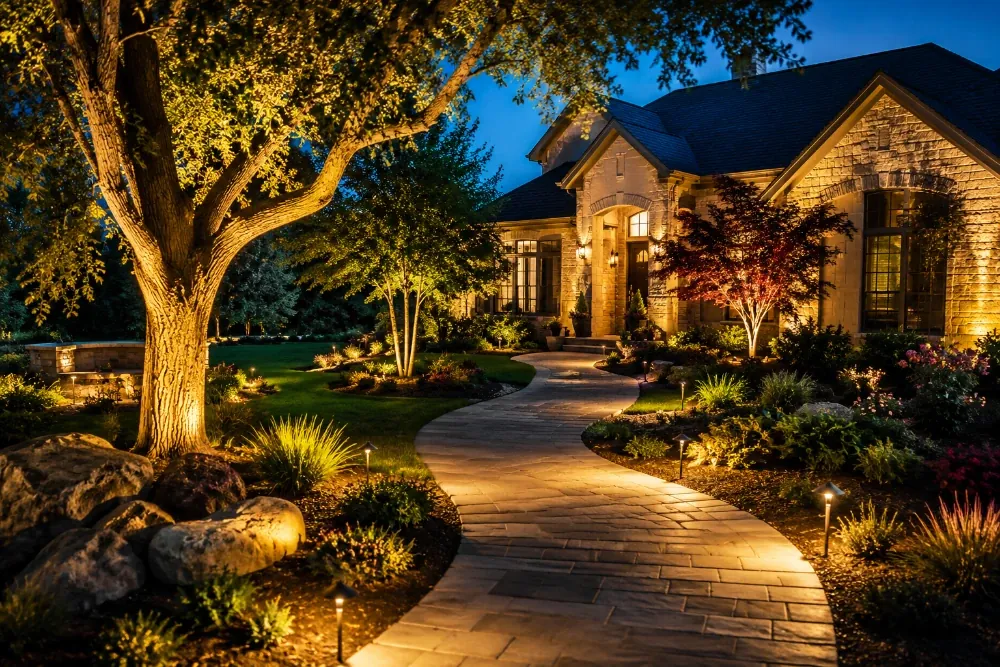
Uplighting remains one of the most dramatic techniques in outdoor design. Fixtures sit near the base of an object and aim upward. Common applications include large oak trees, palms, architectural columns, stone facades and entry features. Done well, uplighting creates focal points that draw attention from across the property. Our architectural uplighting service is built around it.
Downlighting
Downlighting produces a softer, more natural appearance. Fixtures are mounted above the target and shine down, often mimicking moonlight filtering through branches. It works beautifully over patios, seating areas, driveways, walkways and gardens, and many designers favor it because it feels subtle while providing excellent visibility.
Spotlighting
Spotlights direct focused beams toward specific features: sculptures, ornamental trees, water features, unique plantings and architectural accents. A single well-aimed spotlight with the right beam angle can turn an overlooked feature into a nighttime centerpiece.
Flood Lighting
Floodlights provide broader coverage for security, large lawns, driveways and property boundaries. Modern LED floods deliver impressive light with very little energy, but they need shielding and careful aiming. Our security and floodlighting work focuses on visibility without the parking-lot glare.
Step and Deck Lighting
Small fixtures built into steps, decks and retaining walls provide visual guidance, reduce tripping hazards and add elegant ambiance. Even a modest deck feels more upscale when lit properly.
Key Areas of Your Property to Illuminate
Not every square foot needs light. Focus on the areas that deliver the greatest visual and functional impact.
Front Entrance
Your front door creates the first impression. Entry lighting should feel welcoming without overpowering. Consider lighting the doorway, porch columns, entry plantings and the house numbers, which also helps guests and first responders find you.
Driveways
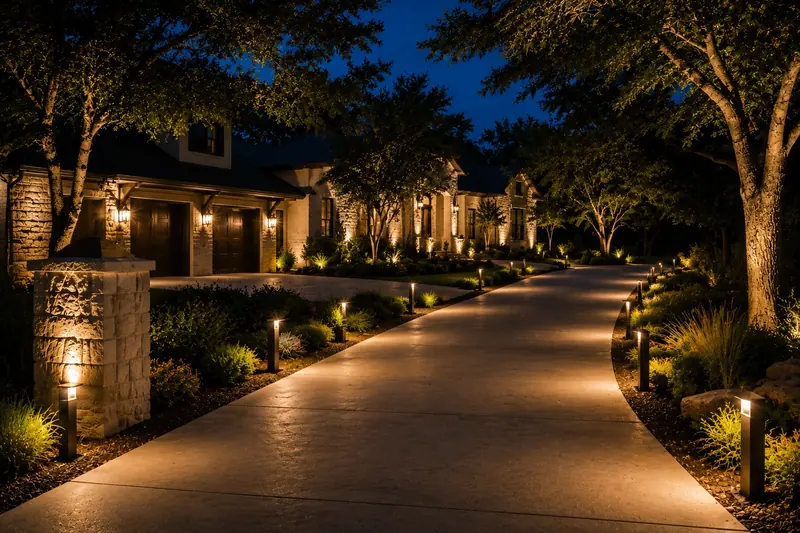
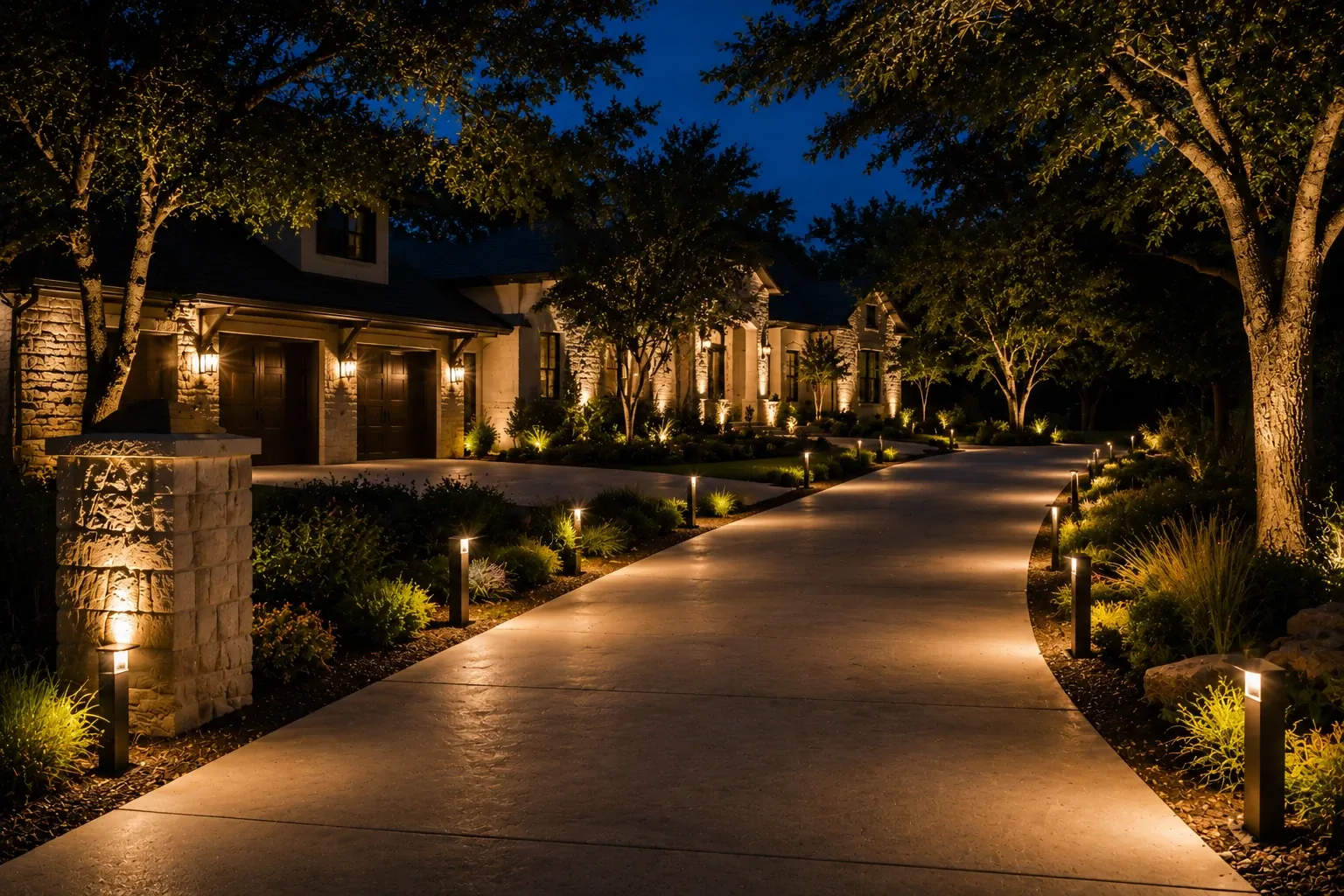
Driveways occupy a lot of visual space, and on larger Texas lots they can run hundreds of feet. Lighting defines their edges and makes arrivals and departures safer. Options include path lights, bollards, downlighting from trees and accent lighting on nearby plantings. See pathway and driveway lighting for layouts.
Walkways and Garden Paths
Guiding movement through the property is essential. Well-placed path lighting improves navigation and creates a warm, inviting atmosphere from the curb to the door and from the patio to the garden.
Trees and Large Plantings
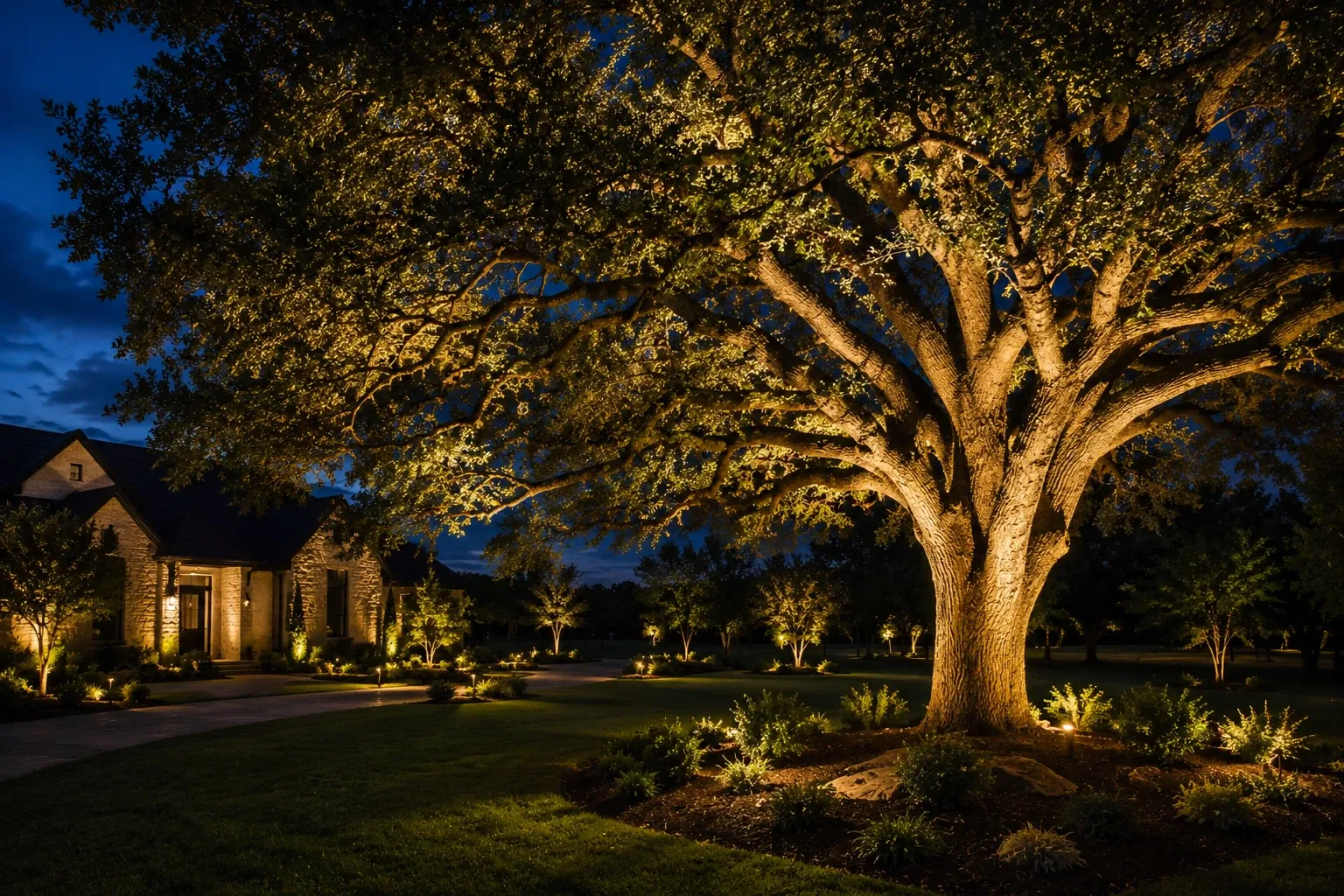
Mature trees are among the most valuable features on many properties, and among the most dramatic lighting opportunities. A broad live oak can take three or four fixtures to light well; a slender crape myrtle may need one or two. Our garden and tree lighting service and our guide to lighting live oak trees go deeper.
| Technique | Effect | Works best on |
|---|---|---|
| Uplighting | Dramatic and bold | Live oaks, palms, tall columns |
| Cross lighting | Adds depth and dimension | Large specimen trees seen from several sides |
| Moonlighting | Natural and subtle | Mature canopies over lawns and patios |
| Silhouetting | Artistic and striking | Agaves, yuccas, sculptural shrubs in front of a wall |
Patios and Outdoor Living Spaces
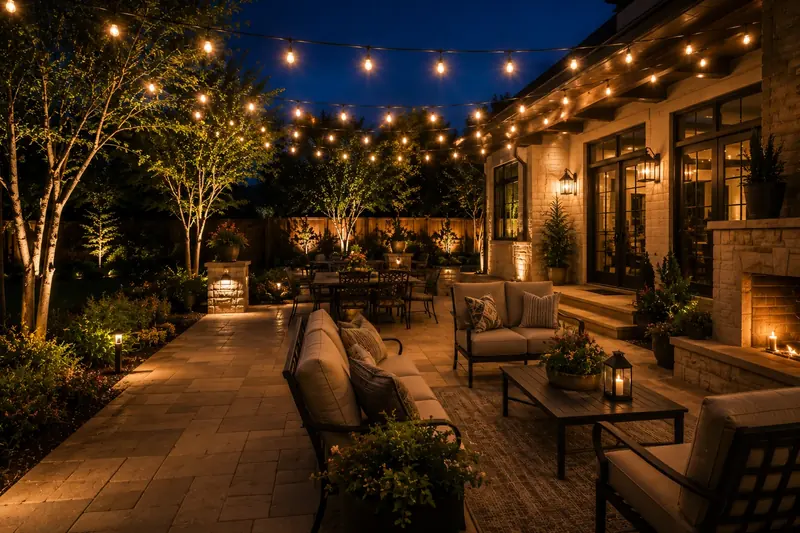
Outdoor living areas should feel comfortable and functional. Layering several light sources, such as downlights, string lights, accent lights, step lights and wall fixtures, usually works best. The goal is a space that feels inviting rather than overly bright. Explore ideas on our patio and outdoor living lighting page.
Pools and Water Features
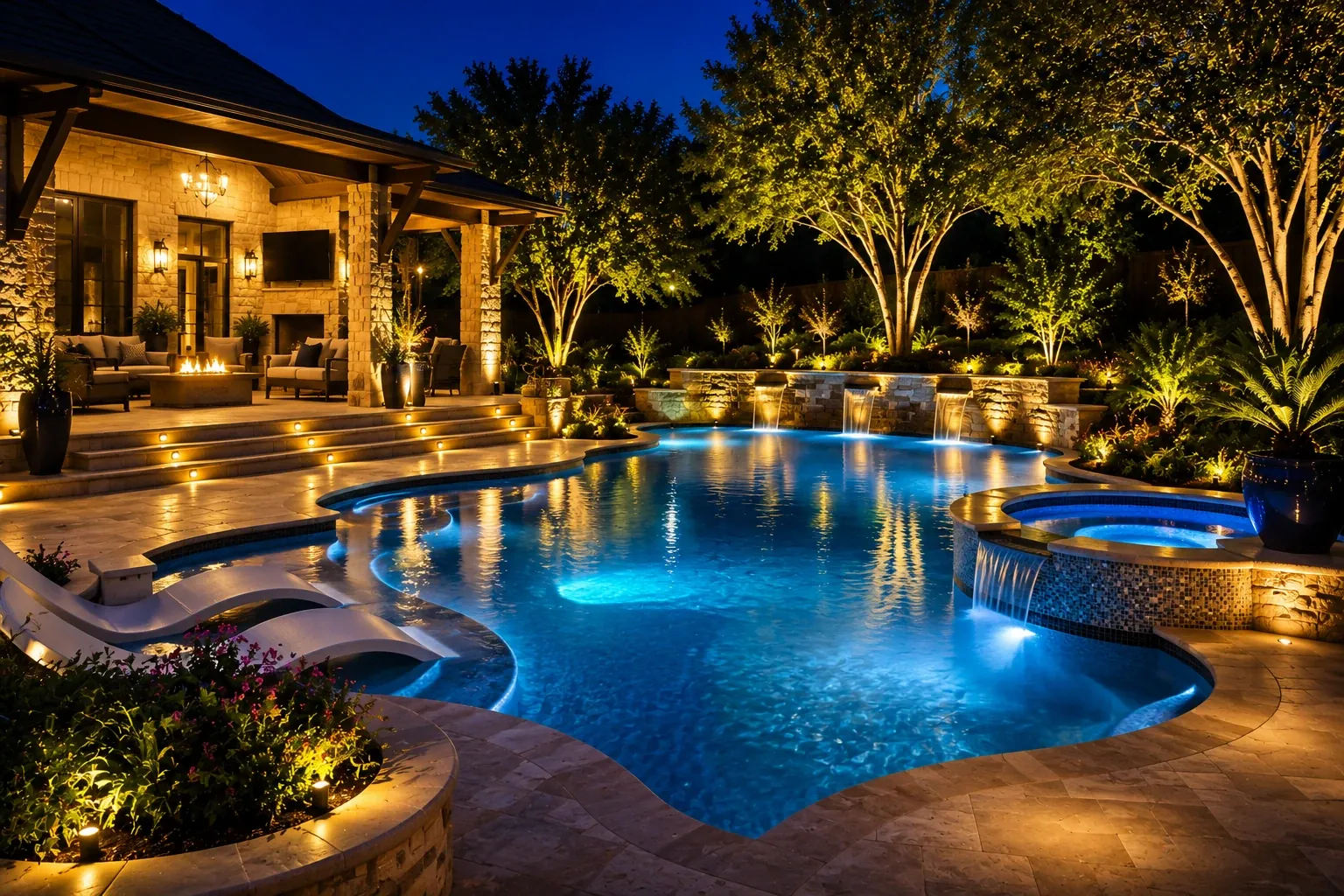
Water interacts beautifully with light; reflections add movement that few other landscape elements can match. Popular applications include pool perimeter lighting, waterfalls, ponds and fountain accents. See pool and water feature lighting.
Popular Landscape Lighting Techniques
The difference between average and exceptional results often comes down to technique. These are the tools professional designers reach for most.
| Technique | Fixture placement | Effect | Typical beam angle |
|---|---|---|---|
| Uplighting | At the base, aimed up | Height and drama | 15°–60° |
| Moonlighting | High in a tree, aimed down | Dappled, natural shadows | 40°–60° |
| Grazing | Close to a wall, aimed along it | Reveals stone and brick texture | Narrow to medium |
| Washing | Set back from a wall | Smooth, even glow | Wide (60°+) |
| Silhouetting | Behind the object, lighting a wall | Dark outline against light | Wide |
| Shadowing | In front, aimed at the object | Shadows cast on a wall | Narrow to medium |
| Cross lighting | Two or more angles | Balanced, three-dimensional | Varies |
Moonlighting
Moonlighting places fixtures high in trees and directs light downward. The effect closely resembles natural moonlight: soft shadows, a natural appearance, broad coverage and elegant ambiance. Texas live oaks, with their wide, low canopies, are ideal hosts.
Silhouetting
Silhouetting positions a light behind an object so it appears dark against a lit surface. It works especially well with ornamental trees, sculptures and architectural plants like agaves and sotol.
Shadowing
Shadowing places a fixture in front of an object to project its shadow onto a nearby surface. Trees with intricate branching, such as crape myrtles in winter, create beautiful patterns on a wall.
Grazing
Grazing highlights texture. Fixtures sit close to the surface, a few inches to a foot away, so even subtle relief becomes prominent. It is the signature technique for limestone, Austin stone and brick facades.
Cross Lighting
Cross lighting uses multiple fixtures from different angles to reduce harsh shadows and create a balanced, sculptural appearance. Professionals use it for large trees and major focal points that are seen from more than one direction.
LED Landscape Lighting: The Modern Standard
Technology has transformed outdoor lighting over the past decade, and LED fixtures now dominate for good reason.
Energy Efficiency
LED fixtures use roughly 75–80% less energy than halogen. A 4-watt LED path light replaces a 20-watt halogen lamp with similar visible output. For homeowners that means lower utility bills, reduced consumption and less environmental impact. A typical whole-property LED system costs about $10–$25 a month to run. Compare scenarios with the LED energy savings calculator or our article on LED vs halogen.
Exceptional Lifespan
Quality LED fixtures deliver tens of thousands of hours of operation before replacement is needed, which reduces maintenance, replacement costs and downtime. LEDs also run far cooler than halogen, which matters when ground temperatures in a Texas summer already push fixtures hard.
Improved Light Quality
Early LEDs sometimes produced harsh, bluish light. Modern fixtures offer warm color temperatures, accurate color rendering (look for a CRI of 90 or higher), smooth beams and consistent performance, so landscapes look natural rather than clinical.
How Low-Voltage Systems Work
Nearly all residential landscape lighting is a 12-volt system. A transformer plugs into an outdoor GFCI outlet and steps 120V household power down to low voltage. Direct-burial cable, usually 12- or 10-gauge, carries power to the fixtures. Over long runs, voltage drops, so a fixture 150 feet away receives less than one near the transformer. Professionals use multi-tap transformers (with 12V, 13V, 14V and 15V outputs) and hub wiring, where several fixtures connect at a single central point, to keep every light at the right voltage. Our low-voltage lighting guide explains it in detail.
Try it: Transformer & Voltage DropSize a low-voltage transformer and check voltage drop by wire gauge.Landscape Lighting Design Principles
Installing fixtures is easy. Creating a memorable outdoor environment is something else entirely. Professional design relies on balance, contrast and intentional placement rather than simply adding more fixtures.
Layered Lighting Creates Better Results
Layering is one of the most effective principles. Instead of relying on a single type of light, successful projects combine several to create depth.
| Lighting layer | Purpose | Examples |
|---|---|---|
| Ambient lighting | General illumination for overall visibility | Moonlighting, wall washing, patio downlights |
| Task lighting | Function for paths, steps and activity areas | Path lights, step lights, grill and kitchen lights |
| Accent lighting | Highlights focal points and architecture | Tree uplights, column grazing, sculpture spots |
A patio, for example, might use downlighting for general visibility, step lights for safety and accent lights on nearby plantings. Together, these layers create a polished, professional appearance.
Avoiding Common Design Mistakes
Many outdoor lighting systems fail not because of poor equipment but because of poor planning.
Overlighting the property. More light does not produce better results. Excess brightness erases the contrast that makes landscapes interesting. Highlight specific features and let some areas stay naturally dark.
Ignoring focal points. Every property needs visual anchors, or the lighting feels random. Good candidates include mature trees, the front entrance, water features, architectural details and outdoor gathering spaces.
Using inconsistent color temperatures. Mixing warm and cool light looks disjointed. Most residential systems perform best with warm white in the 2700K to 3000K range, kept consistent across the property.
Visible glare. If you can see the bright source from the street or a patio chair, the fixture needs a shroud, a different angle or a better location.
Creating Balance and Visual Interest
Professional designers understand that shadows are as important as light. The goal is not to illuminate everything; it is to create contrast. When certain areas are highlighted and others stay subdued, the landscape gains dimension and character. That principle separates exceptional designs from average installations, and it is also the heart of dark-sky practice: light where you need it, aimed down or at a surface, never into the sky or a neighbor's window.
Planning Your Landscape Lighting Project
A good plan starts long before the first fixture goes in the ground.
- Walk the property at night. Note where you naturally look from the street, the driveway and your favorite chair outside. Those sightlines decide what to light.
- List priorities. Curb appeal, safe paths, security, entertaining or all four. Priorities set the budget split between zones.
- Pick focal points. Choose two or three hero features: a live oak, the entry, a stone chimney. Build the design around them.
- Plan zones and controls. Separate the front, back, trees and pool so each can run on its own schedule.
- Size the infrastructure. Add up fixture wattage, choose a transformer with about 20% headroom, and plan cable routes and gauges for voltage drop.
- Check HOA and site conditions. Get any HOA approval you need, locate irrigation lines, and call 811 before digging.
- Test at night. Aim and adjust after dark; this step makes or breaks the result.
Not sure where to start? The lighting style quiz suggests a plan from six quick questions, and the beam spread calculator helps match beam angles to tree heights.
Landscape Lighting for Texas Homes
Texas properties present unique opportunities and challenges. From suburban lots in Katy and Frisco to Hill Country acreage and West Texas ranches, outdoor lighting must perform reliably in demanding conditions.
The Challenges of the Texas Climate
Texas weather is unpredictable, and outdoor lighting must withstand extreme heat, intense sun, heavy rain, high humidity and severe storms, including hail. Each region adds its own stress:
- Central Texas and the Hill Country: shallow, rocky soil and limestone ledges make trenching harder; dark-sky expectations are strong. See Austin and San Antonio.
- Houston and Southeast Texas: humidity, heavy rain and fast-growing plants that swallow fixtures. See Houston.
- North Texas: hail, freezes and expansive clay soil that shifts fixtures out of alignment. See Dallas–Fort Worth.
- West Texas: wind, dust, caliche and big temperature swings. See West Texas.
- The coast: salt air that corrodes cheap aluminum and steel. See Gulf Coast.
Because of these conditions, fixture quality matters. Cheap materials often deteriorate quickly under Texas exposure.
Best Fixture Materials for Texas Landscapes
Brass. Solid cast brass develops a natural patina while resisting corrosion. It offers exceptional durability, long service life, a premium look and minimal maintenance, and it is the top choice for coastal properties.
Copper. Copper fixtures are known for beauty and longevity. Many homeowners appreciate the character copper develops as it ages to a deep bronze or verdigris.
Aluminum. High-quality aluminum balances affordability and durability. Powder-coated finishes protect against the weather, though chips and scratches can let corrosion start, especially near salt water or sprinklers.
Whatever the material, look for sealed lenses and gaskets with an IP65 rating or better (IP67 for in-grade, IP68 for underwater), and waterproof, gel-filled wire connections.
Lighting Larger Texas Properties
Many Texas homes sit on larger lots than in other parts of the country, which creates exciting opportunities: long driveways, entry monuments and gates, large specimen trees, extensive gardens and outdoor entertainment areas. Rather than lighting everything, focus on key features that establish rhythm through the landscape. Long distances also make voltage drop and transformer placement critical, which is where professional planning pays off.
What Does Landscape Lighting Cost in Texas?
Most residential projects run $2,500 to $12,000. A starter package for a front elevation and walk typically falls between $2,500 and $5,000, while full estate designs can exceed $20,000. Professionally installed fixtures generally average about $250–$450 each, including their share of the transformer, cable, labor and aiming. These are planning ranges; your site, fixture grade and controls determine the final number.
Try it: Cost CalculatorEstimate fixtures, installation, transformer size and running cost.How Landscape Lighting Can Increase Property Value
Homeowners usually install outdoor lighting for beauty and safety, but the financial side deserves a look too.
Enhanced Curb Appeal
First impressions matter. A beautifully lit home stands out, whether visitors arrive in person or buyers scroll listing photos taken at twilight.
Stronger Buyer Perception
Buyers often associate professional lighting with quality and attention to detail. It signals that the owner invested in the property beyond basic maintenance.
Improved Outdoor Living Appeal
Buyers increasingly seek outdoor kitchens, covered patios, fire pits and entertainment spaces. Lighting extends the usability of those spaces and raises their perceived value.
Potential Return on Investment
Exact returns vary by market, but the benefits go beyond the math: improved function, more enjoyment, better security and stronger curb appeal. The value is experienced every evening you own the home.
Professional Installation vs DIY Landscape Lighting
Whether professional installation is worth it depends on the project's complexity and the results you want.
Benefits of Professional Installation
Professionals bring custom design planning, proper beam angle selection, voltage calculations, precise fixture positioning and long-term reliability. Experienced designers know how light behaves at night and anticipate problems before installation begins.
Benefits of DIY Installation
DIY kits offer lower upfront cost, simpler installation and the flexibility to expand gradually. For small projects, such as a garden path, a flower bed accent or deck lights, DIY can work well.
Comparing the Options
| Factor | Professional installation | DIY installation |
|---|---|---|
| Design expertise | High | Limited |
| Customization | Extensive | Moderate |
| Initial cost | Higher | Lower |
| Voltage drop and transformer sizing | Calculated | Often guessed |
| Long-term performance | Excellent | Variable |
| Warranty | Product plus workmanship | Product only |
| Time commitment | Minimal for homeowner | Significant |
For dramatic, cohesive results, professional installation typically delivers the greatest value. Landscape Lighting Texas backs every install with a 5-year workmanship warranty.
Smart Controls and Automation
Controls decide how much you enjoy a system day to day. A basic photocell turns lights on at dusk; an astronomical timer tracks sunset by date and location, so lights come on at the right time in June and December without adjustment. Smart systems add app control, zones, dimming, scenes and smart-home integration, so you can keep the entry lit until dawn while turning the backyard off at 11. Find dusk times for your city with the Texas dusk timer.
Maintaining Your Landscape Lighting System
Even the best systems need occasional attention. Fortunately, maintenance is straightforward. Our seasonal maintenance checklist covers the details, and our maintenance and repair team can handle it for you.
Perform Routine Inspections
Walk the property every few months after sunset. Look for burned-out fixtures, misaligned lights, damaged wiring and areas blocked by vegetation. Catching small issues early prevents larger ones.
Clean Fixtures Regularly
Dirt, pollen, hard-water spots from sprinklers and debris accumulate on lenses. Cleaning them periodically restores brightness and beam quality, often dramatically.
Trim Growing Vegetation
Landscapes evolve. A fixture that perfectly lit a tree last year may be buried by new growth this year, especially after a wet Texas spring. Routine pruning preserves the intended effects.
Check Connections
Weather, irrigation, shifting clay soil and ground movement can affect wire connections. Inspecting them periodically, and checking voltage at the far fixtures, keeps the system reliable.
Update Controls and Automation
Modern systems often include timers, smart controls, app integration and seasonal scheduling. Reviewing settings through the year, and after power outages, keeps performance and efficiency where they should be.
Frequently Asked Questions About Landscape Lighting
How many fixtures does a property need?
It depends on the property's size and your goals. A front elevation often needs 12 to 20 fixtures; a full property can need 30 or more. A quality plan focuses on strategic placement rather than fixture quantity.
What is the best color temperature?
Most residential properties look best with warm white between 2700K and 3000K, which feels welcoming and natural on stone, brick and foliage.
Is LED landscape lighting worth it?
Yes. LEDs use about 75–80% less energy than halogen, last far longer and offer better light quality and control than older technology.
Can existing systems be upgraded?
In many cases, yes. Existing systems can often be modernized with LED fixtures or lamps, upgraded multi-tap transformers and smart controls.
Is low-voltage lighting safe?
Yes. At 12 volts, low-voltage systems are widely used in residential settings and are considered safe around people, pets and irrigation when installed properly.
How long does installation take?
Most residential installations are finished in one day; larger estates and commercial properties may take two to three. See more answers on our FAQ page.
Final Thoughts
Exceptional landscape lighting does more than illuminate a property. It transforms how a home is experienced after dark. The right design enhances curb appeal, improves safety, strengthens security and extends the usability of outdoor living spaces. Most of all, it highlights the features that make a property unique.
Whether you are lighting a grand oak, guiding visitors along a garden path or creating an inviting patio, every fixture should serve a purpose. The most successful projects are never about adding the most lights; they are about balance, focal points and a beautiful nighttime experience.
When thoughtfully designed and professionally installed, landscape lighting becomes one of the most impactful investments a homeowner can make. If you are ready to see what is possible, browse the gallery or request a free consultation with Landscape Lighting Texas.

Our lighting designers have planned and aimed more than 1,400 outdoor lighting systems across Texas. More about us.