25 Landscape Lighting Ideas for Texas Homes
The best landscape lighting ideas for Texas homes start with what you already have: a limestone facade, a sprawling live oak, a pool you use until October and an outdoor kitchen that earns its keep in every season. Good lighting does not add clutter. It picks out the strongest features, connects them with safe, soft light and keeps glare out of everyone's eyes.
Below are 25 ideas our designers at Landscape Lighting Texas return to again and again, grouped by part of the property. Each one comes with a practical fixture tip, so you can tell a good plan from a pile of stake lights. Mix and match them; most beautiful systems use six to ten of these ideas, not all twenty-five.
Front of house
The front elevation is what neighbors, guests and buyers see first. Aim for balance: light the architecture, not the windows, and let the darkness between features do some of the work.
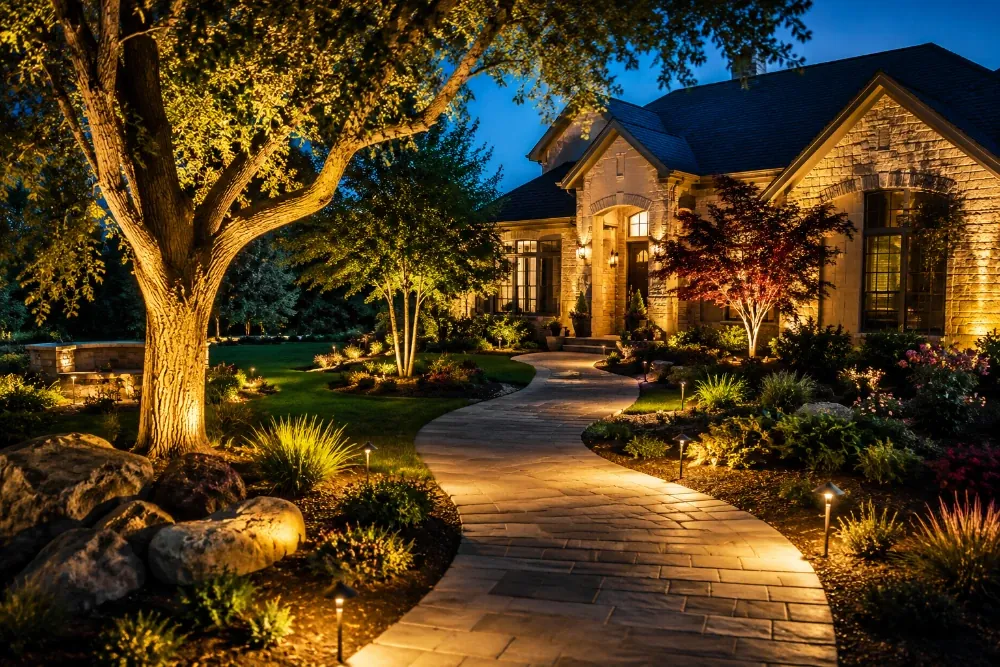
1. Graze a limestone or Austin stone facade
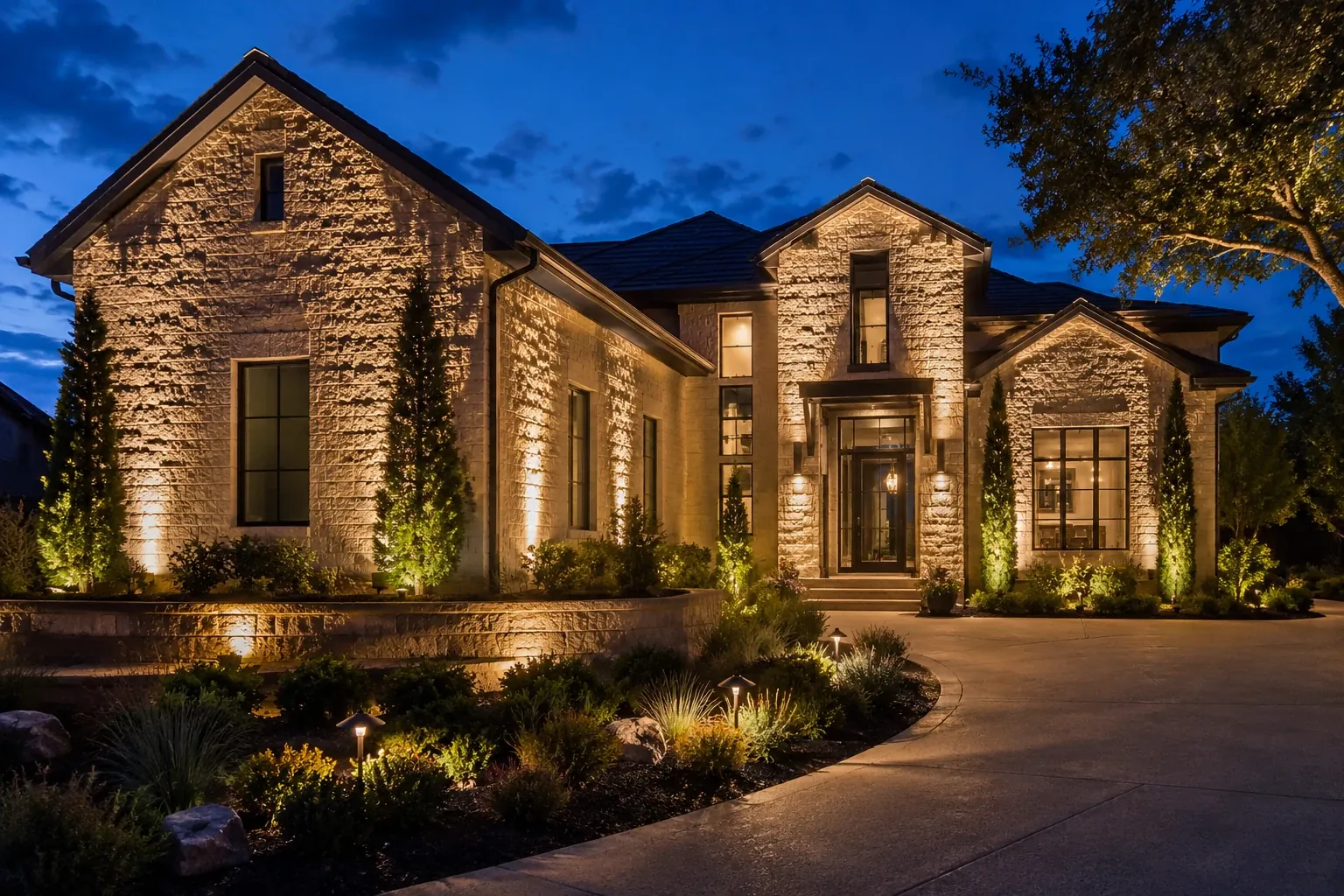
Textured stone is made for grazing. Place uplights 6–12 inches from the wall and aim almost straight up so the light skims across the surface and every ledge throws a small shadow. The result reads as depth and craftsmanship instead of a flat, washed wall. Fixture tip: use a narrow 15–25° beam in 2700K brass bullets, roughly 4–6 feet apart, and keep them out of window openings. See our architectural uplighting service for more examples.
2. Wash smooth stucco and painted brick evenly
Smooth surfaces show every hot spot, so the approach flips: pull the fixture back 2–3 feet from the wall and use a wider beam to blend the light. Overlapping wash fixtures give a calm, even glow on Mediterranean and modern farmhouse homes. Fixture tip: 40–60° flood optics at 3000K on white or cream stucco; check the overlap at dusk and adjust before the stakes are set.
3. Frame the front entry with columns
Columns and pilasters flanking a front door create a natural frame. Light each one from its base with a tight beam so the column glows while the door stays the focal point between them. Fixture tip: one narrow-beam (10–15°) uplight per column, placed close and slightly in front; add a glare cowl so the lamp is invisible from the sidewalk.
4. Light the gables and rooflines sparingly
A tall gable or a stone chimney can carry a home's silhouette at night, but lighting every peak looks busy. Pick the one or two strongest vertical elements and let the rest fall into soft shadow. Fixture tip: a higher-output 8–12 watt LED with a spot beam reaches a second-story gable without needing a floodlight on the eave.
5. Make the house number easy to find
A lit address is a small detail that helps guests, delivery drivers and emergency responders. It also makes a strong first impression from the curb. Fixture tip: a small wall-wash or adjustable spot aimed across a stone or monument address marker, at the same color temperature as the rest of the facade.
Trees and gardens
Texas trees are the backbone of most night scenes. Live oaks, cedar elms, crape myrtles and palms each want a different technique. Our garden and tree lighting page covers the full range.
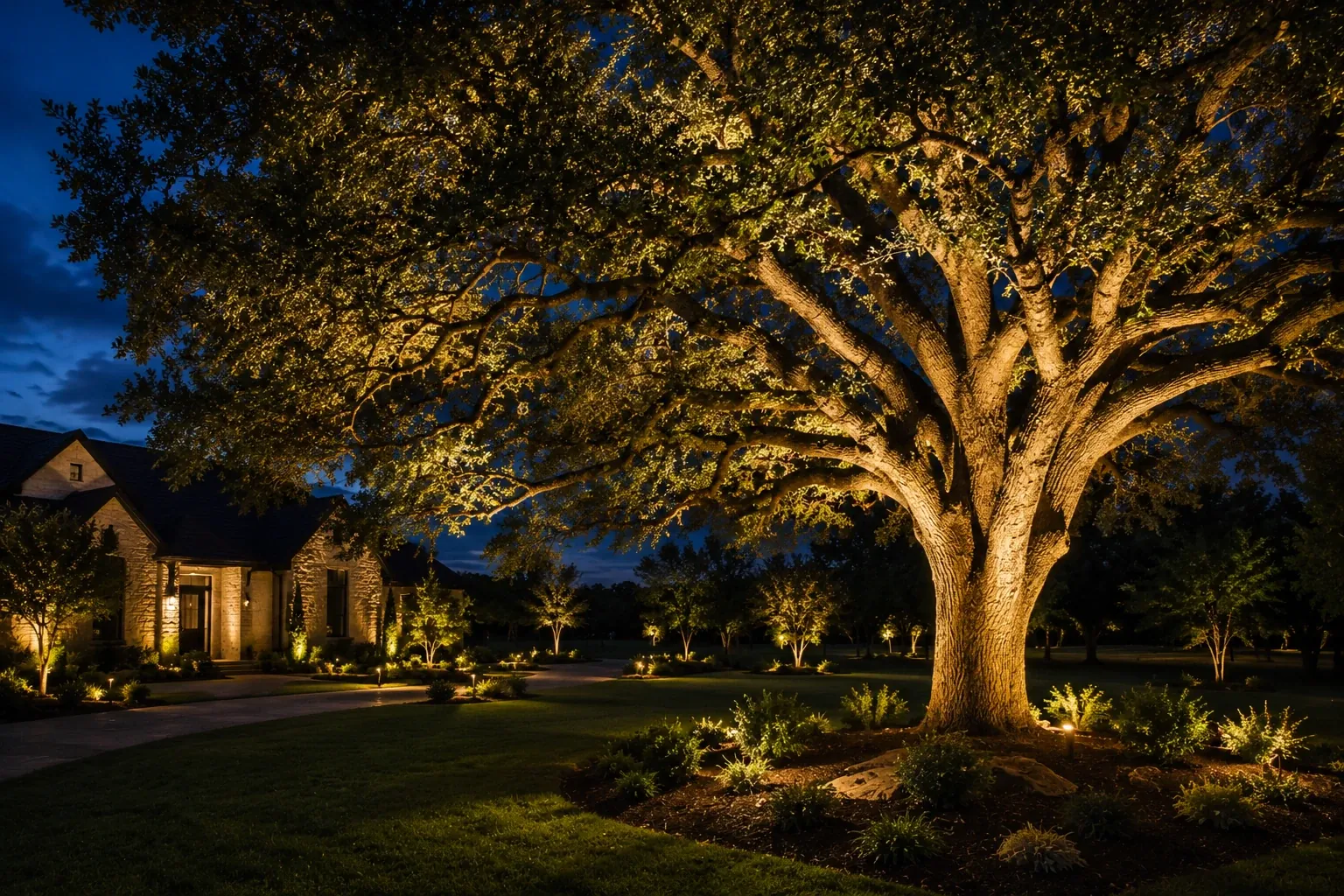
6. Uplight a live oak from several angles
A mature live oak spreads wider than it is tall, so one light rarely does it justice. Place two to four fixtures around the trunk, some aimed into the main limbs and some reaching toward the outer canopy, so the tree reads as three-dimensional from the street. Fixture tip: mix 25° and 36° beams at 2700K. Our guide on how to light live oak trees walks through the counts by canopy width.
7. Moonlight from high in the canopy
Mounting downlights 20–30 feet up in a big oak casts dappled, leaf-shadow patterns across the lawn, like a full moon through branches. It is the most natural-looking effect in landscape lighting. Fixture tip: use adjustable tree-mount downlights with a stainless strap or lag screw, leave slack for growth and run the wire in a UV-rated conduit up the trunk.
8. Silhouette a crape myrtle against a wall
Crape myrtles have sculptural, smooth trunks. Place a wide wash behind the tree, aimed at the wall or fence beyond it, and the branches appear as a dark outline against glowing stone. Fixture tip: a 60° wash fixture between the plant and the wall, hidden low in the bed; 2700K keeps the backdrop warm.
9. Shadow-play on a blank wall
Reverse the idea: light the plant from the front and let it cast a large, soft shadow onto a fence, a garage wall or a side elevation. Agaves, sotols and yuccas throw dramatic shapes. Fixture tip: place a medium-beam spot low and a few feet in front of the plant; moving it closer makes the shadow bigger and softer.
10. Light palms on the coast and in the Valley
Palms are vertical, so they need light that climbs. A tight beam at the base of each trunk shows the bark texture and catches the underside of the fronds. Along the Gulf Coast, salt air demands solid brass or copper fixtures. Fixture tip: one 10–15° uplight per trunk for tall palms, or a well light set on the side the home faces.
11. Add depth with a few lit planting beds
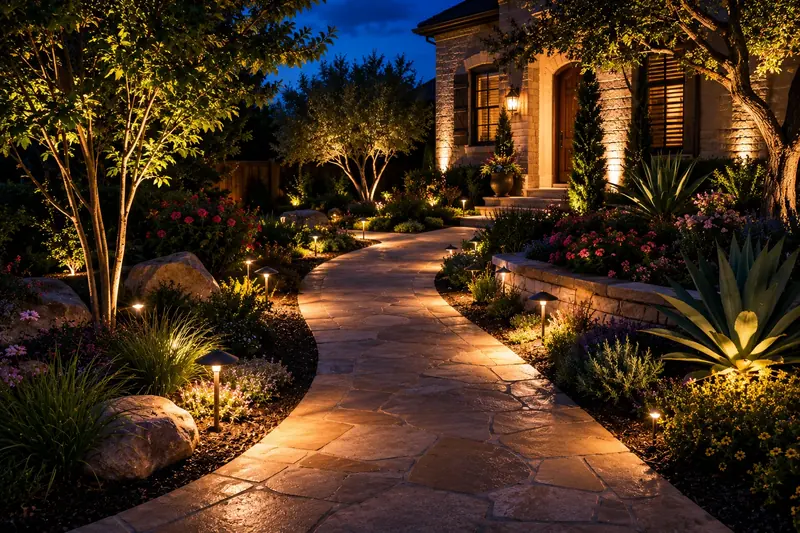
Beds of salvia, lantana or ornamental grasses look flat in the dark until a few low fixtures bring them forward. You only need a handful to create a middle ground between the house and the lawn. Fixture tip: small area lights or hat-style path lights tucked into the bed at 2700K, 6–10 feet apart.
Paths and driveways
Walkway and driveway lighting is about safe footing first and beauty second. Pools of light work better than a lit runway. See our pathway and driveway lighting service for layouts.
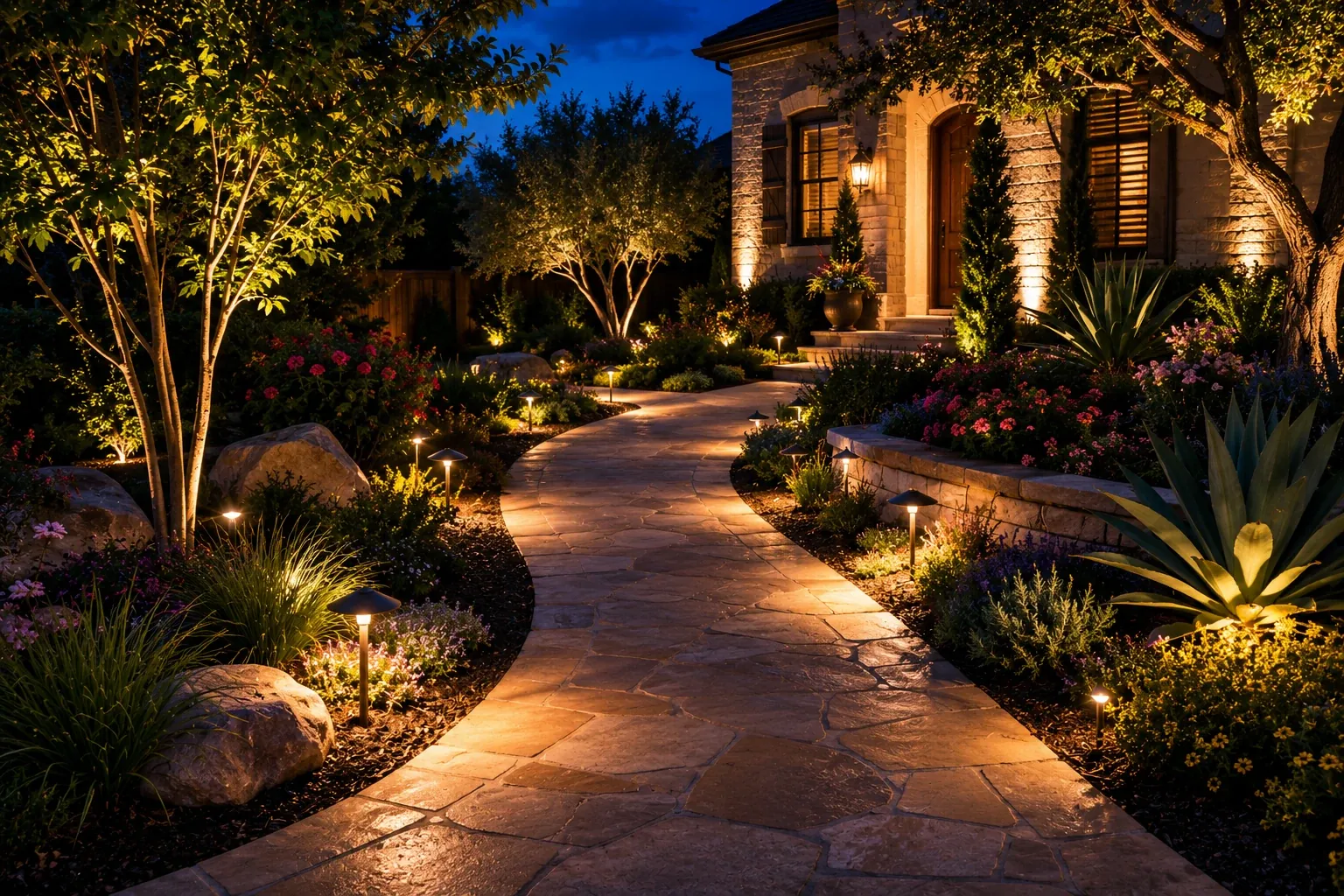
12. Stagger path lights instead of lining them up
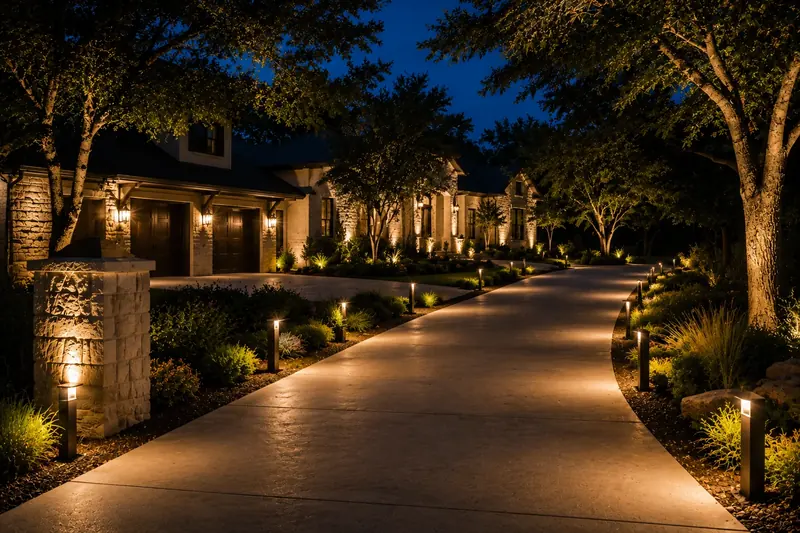
Two parallel rows of lights on either side of a walk is the most common mistake we see. Alternate sides and space fixtures so the pools of light just touch on the ground. Fixture tip: 2–3 watt LED path lights with a hood, spaced 8–10 feet apart and set 6–12 inches back from the walk edge so mowers and feet miss them.
13. Light steps with recessed step lights
Stone steps and changes in grade are where people trip. Small fixtures built into the riser cast light down across each tread without any glare. Fixture tip: louvered step lights installed every second or third riser during construction, or surface-mount brick lights on existing walls.
14. Line a long driveway with low bollards
Country properties and Hill Country lots often have long drives with no streetlights. Low bollards or path lights at the curves mark the edge and make the approach feel welcoming. Fixture tip: 24-inch bollards with a downward louver at 30–40 foot intervals, closer at curves and the entry gate.
15. Mark the driveway edge with in-grade lights
Flush, drive-over fixtures set into the pavement or the border mark the edge without anything to clip. They suit modern homes and tight drives. Fixture tip: choose fixtures rated for vehicle loads with a lens that sheds water; in clay soil, set them on a gravel base so they drain.
16. Light the entry gate and pillars
Stone or brick pillars at the drive entrance announce the property after dark. A small uplight on each pillar, or a cap light on top, is enough. Fixture tip: match the beam and output on both pillars; even slight differences look lopsided from the road.
Pools and water
Water doubles every light near it as a reflection. A few well-placed fixtures around the pool, fountain or pond carry the whole backyard. More ideas on our pool and water feature lighting page.
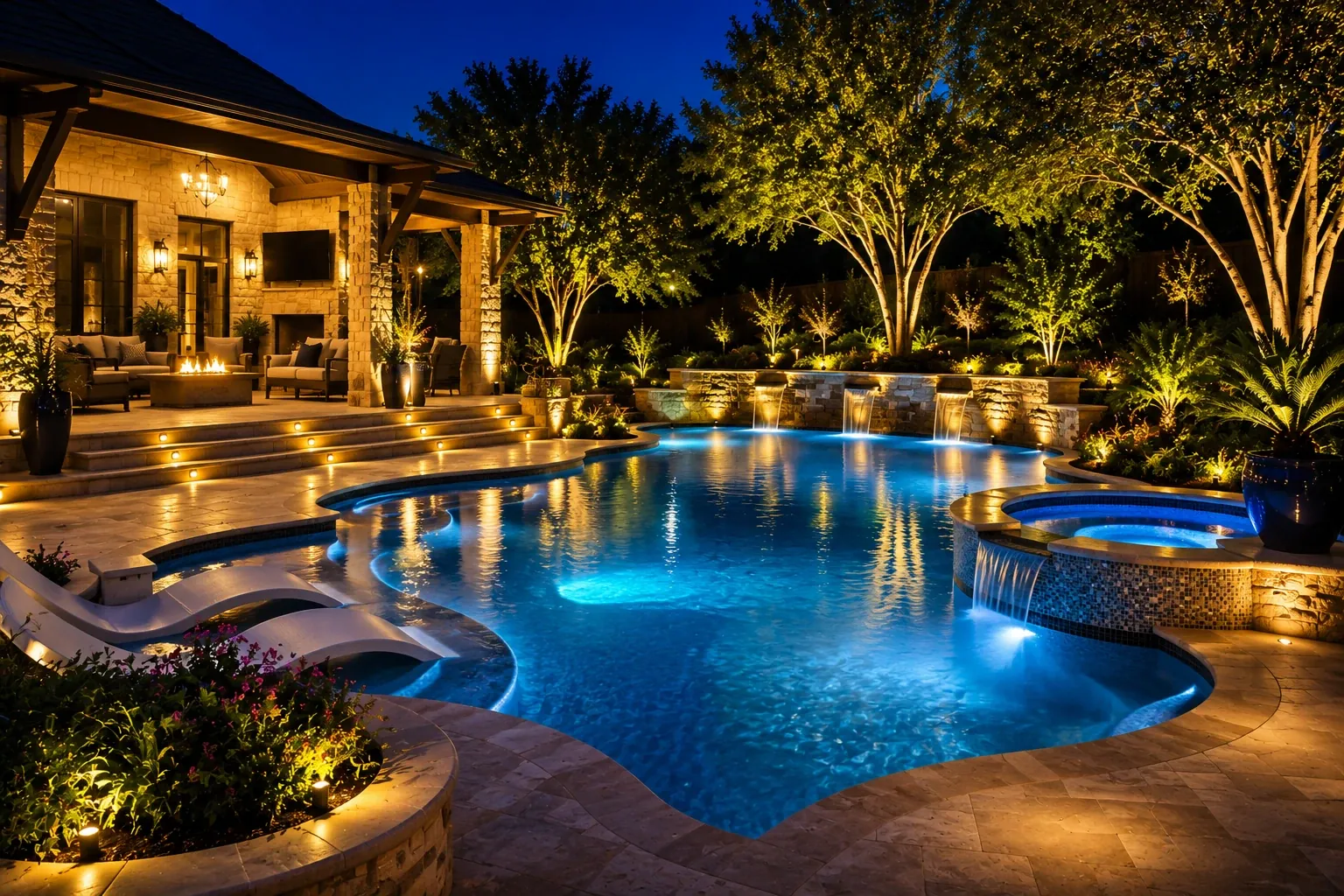
17. Light the landscape around the pool
The pool light handles the water, but the plants, walls and trees around it set the mood. Uplight a few palms or a back wall so the reflections dance across the surface. Fixture tip: keep fixtures clear of splash zones and wet decks; use 2700K–3000K so the warm surround contrasts with the cooler pool water.
18. Highlight a fountain or sheer descent
Moving water catches light beautifully. Small submersible fixtures beneath a spillway or fountain jets make the water itself glow. Fixture tip: submersible fixtures with an IP68 rating, cleaned at least twice a year in hard Texas water to remove mineral scale.
19. Use a reflecting pond or still water as a mirror
A still pond or rill can reflect a lit tree or facade behind it. Light the object, not the water, and the reflection does the rest. Fixture tip: position the uplights on the far side of the water so the beam never shines directly toward the main viewing area.
Patios and outdoor living
Texans spend nine or ten months a year outside. Patio lighting should be layered so you can cook, eat and relax under the same fixtures. Our patio and outdoor living lighting service goes deeper.
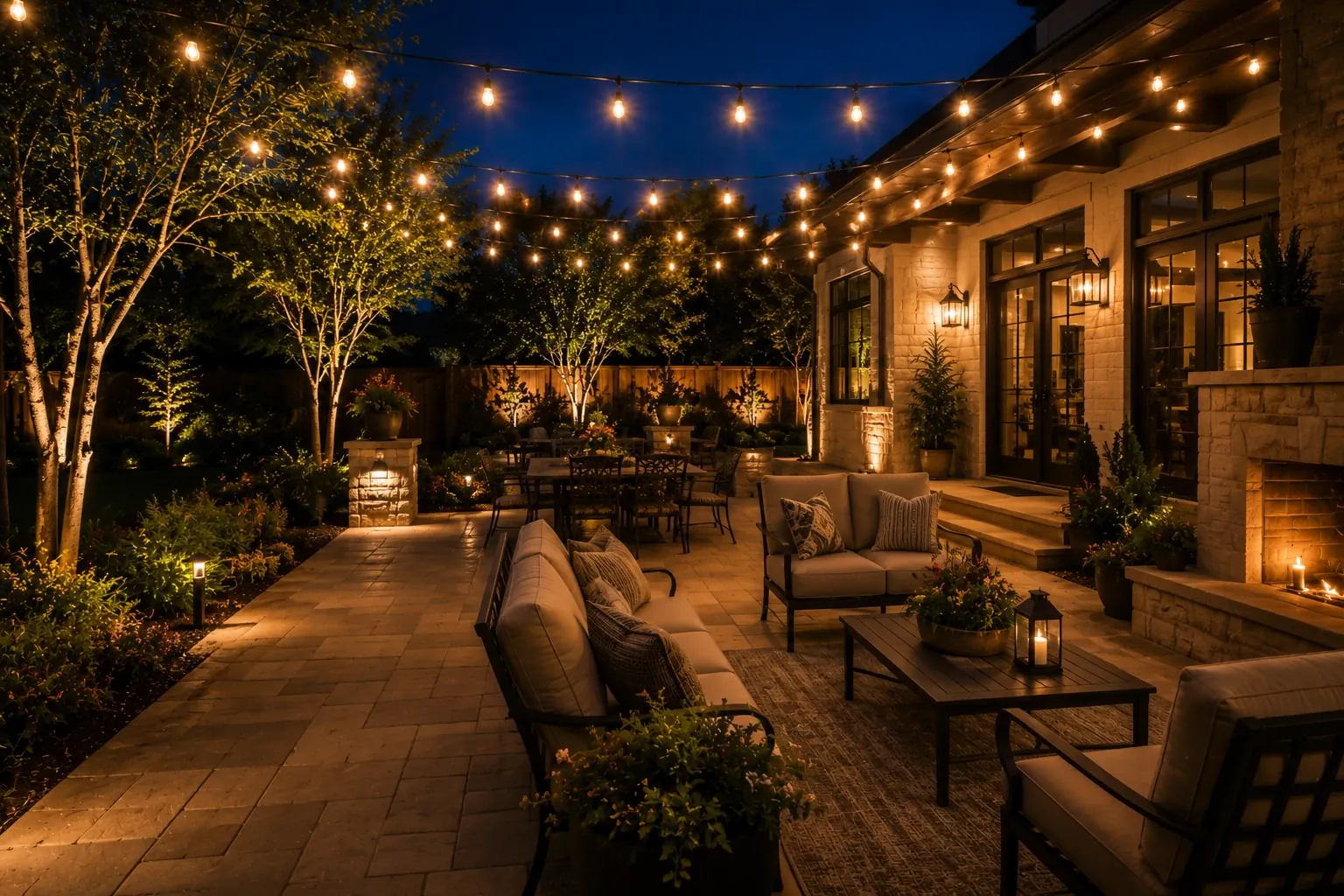
20. Downlight pergolas and cabanas
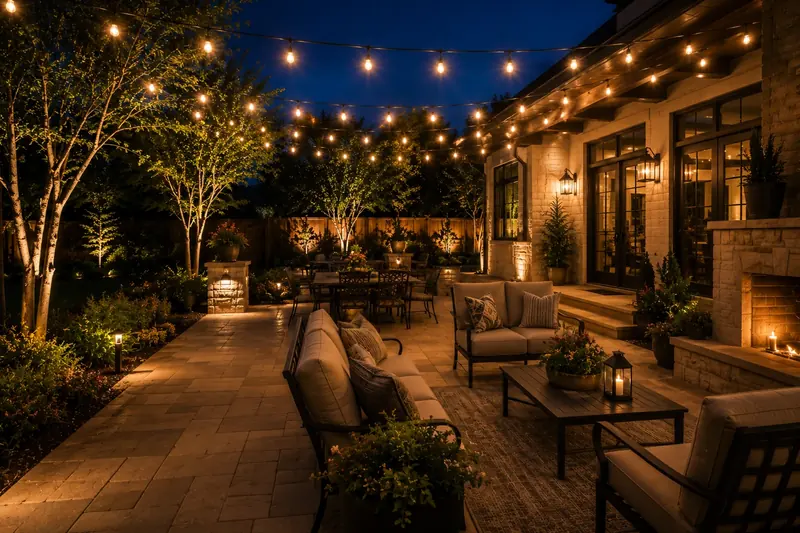
Small downlights tucked into pergola beams create soft, even light over a dining table or seating area. They are hidden during the day and far less glaring than a single bright floodlight. Fixture tip: 3–4 watt adjustable downlights mounted on beams, on a dimmable zone so you can turn them down after dinner.
21. Task-light the outdoor kitchen
Grilling in the dark is hard. Under-counter strip lights and a focused downlight over the cooking area give real working light, while the rest of the patio stays warm and dim. Fixture tip: 3000K for the kitchen zone, which is a touch crisper for food prep; keep strips sealed and rated for wet locations.
22. Hang bistro string lights the right way
String lights sell the Texas backyard feel, but sagging cords and bare cheap bulbs quickly look worn. Use heavy-duty commercial strands on a steel guide wire and tie them to posts or the eave. Fixture tip: shatterproof LED filament bulbs at 2200K–2700K, on their own dimmable circuit separate from the landscape lights.
23. Add steps and seat-wall lights
Built-in seat walls, fire pits and raised beds are perfect hosts for small hardscape lights. They provide wayfinding and a glow at knee height, which feels intimate. Fixture tip: low-profile hardscape lights under the cap stone, installed during construction so the wire is hidden in the wall.
Smart controls and finishing touches
The last few ideas are about control and quality. They are what make a system easy to live with for years. See our smart lighting systems page for the options.
24. Run on an astronomical timer with zones
Sunset in Texas shifts by more than two hours between December and June. An astronomical timer follows dusk automatically, and zones let you leave the facade on all night while the patio switches off at 11pm. Fixture tip: pair a multi-tap transformer with a smart controller or app-based module so you can change schedules from your phone. Our Texas Dusk Timer shows sunset times by month for your city.
25. Keep color temperature consistent and the light dark-sky friendly
Nothing breaks a design faster than a mix of warm and cool fixtures. Choose one main color temperature for the whole property and shield every fixture so the light lands on the target, not in the sky or the neighbor's bedroom. Fixture tip: 2700K for most stone, plants and trees; 3000K for white stucco or modern homes. Read our color temperature guide for details.
Try it: Lighting Design SimulatorSwitch lighting zones on a Texas home, dim them and try scenes.How to combine these ideas into one plan
The ideas above work best as layers rather than a shopping list. A good sequence for most Texas homes looks like this:
- Pick two or three focal points. Usually the facade, the largest tree and the front entry.
- Add safety lighting. Paths, steps and the driveway, so guests can find their way without glare.
- Fill the middle ground. A few beds or smaller trees so the yard has depth.
- Extend into the backyard. Patio layers, pool surround and any water features.
- Tie it together with controls. Zones, dimming and an astronomical timer.
| Area | Typical fixtures | Beam / color |
|---|---|---|
| Stone facade | Uplights 4–6 ft apart | 15–25°, 2700K |
| Stucco facade | Wash lights 2–3 ft off the wall | 40–60°, 3000K |
| Mature live oak | 2–4 uplights, optional downlights | 25–36°, 2700K |
| Walkway | Path lights 8–10 ft apart, staggered | Hooded, 2700K |
| Patio / pergola | Downlights, strings, step lights | Dimmable, 2200K–3000K |
As a planning range, most residential projects run $2,500–$12,000, or roughly $250–$450 per installed fixture professionally. Our landscape lighting cost calculator gives a quick estimate for your property, and the gallery shows how these ideas look on real Texas homes.
Frequently Asked Questions
How many landscape lights does a typical Texas home need?
A typical front yard uses 10–20 fixtures; a front and back design often lands between 20 and 40. The count depends on the facade width, the number of trees and the length of your paths more than on square footage.
What is the best color temperature for landscape lighting in Texas?
2700K suits most limestone, brick, trees and plants because it brings out warm tones. 3000K works well for white stucco, modern homes and outdoor kitchens. Keep one main color temperature across the property for a consistent look.
Will landscape lighting hold up to Texas heat and hail?
Professional-grade solid brass or copper fixtures with sealed LED modules handle heat, humidity and coastal salt far better than aluminum or plastic kits. Fixtures sit low, so hail rarely damages them, but lenses should be cleaned and checked each spring.
Do I need HOA approval for landscape lighting?
Many Texas HOAs have rules about light trespass, color and brightness, especially for floodlights. Low-glare, shielded, warm white fixtures usually comply easily, but check your deed restrictions before installation.
Ready to turn a few of these ideas into a plan for your home? Landscape Lighting Texas offers free dusk consultations and aims every fixture on-site after dark. Request your free quote and we will help you pick the ideas that suit your property best.

Our lighting designers have planned and aimed more than 1,400 outdoor lighting systems across Texas. More about us.